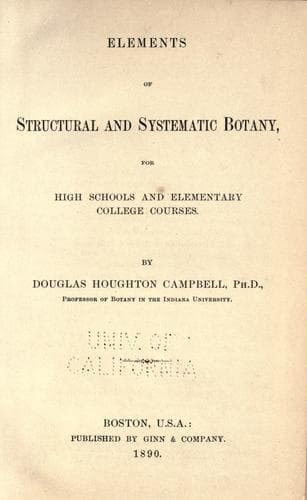
Elements of Structural and Systematic Botany: For High Schools and Elementary College CoursesCampbell, Douglas Houghton
Science
Elements of Structural and Systematic Botany: For High Schools and Elementary College Courses
Campbell, Douglas Houghton
Botany -- Textbooks
The fifth order (_Myrtifloræ_) have regular four-parted flowers with
usually eight stamens, but sometimes, through branching of the
stamens, these appear very numerous. The myrtle family, the members of
which are all tropical or sub-tropical, gives name to the order. The
true myrtle (_Myrtus_) is sometimes cultivated for its pretty glossy
green leaves and white flowers, as is also the pomegranate whose
brilliant, scarlet flowers are extremely ornamental. Cloves are the
dried flower-buds of an East-Indian myrtaceous tree (_Caryophyllus_).
In Australia the order includes the giant gum-trees (_Eucalyptus_),
the largest of all known trees, exceeding in size even the giant trees
of California.
Among the commoner _Myrtifloræ_, the majority belong to the two
families _Onagraceæ_ and _Lythraceæ_. The former includes the evening
primroses (_Œnothera_), willow-herb (_Epilobium_) (Fig. 113, _D_),
and fuchsia; the latter, the purple loosestrife (_Lythrum_) and swamp
loosestrife (_Nesæa_). The water-milfoil (_Myriophyllum_) (Fig. 113,
_J_) is an example of the family _Haloragidaceæ_, and the _Rhexias_ of
the eastern United States represent with us the family _Melastomaceæ_.
The sixth order of the _Calycifloræ_ is a small one (_Thymelinæ_),
represented in the United States by very few species. The flowers are
four-parted, the calyx resembling a corolla, which is usually absent.
The commonest member of the order is the moosewood (_Dirca_)
(Fig. 113, _A_), belonging to the first of the three families
(_Thymelæaceæ_). Of the second family (_Elæagnaceæ_), the commonest
example is _Shepherdia_, a low shrub having the leaves covered with
curious, scurfy hairs that give them a silvery appearance. The third
family (_Proteaceæ_) has no familiar representatives.
The seventh order (_Rosifloræ_) includes many well-known plants, all
of which may be united in one family (_Rosaceæ_), with several
sub-families. The flowers are usually five-parted with from five to
thirty stamens, and usually numerous, distinct carpels. In the apple
and pear (Fig. 114, _I_), however, the carpels are more or less grown
together; and in the cherry, peach, etc., there is but a single carpel
giving rise to a single-seeded stone-fruit (drupe) (Fig. 114, _E_,
_H_). In the strawberry (Fig. 114, _A_), rose (_G_), cinquefoil
(_Potentilla_), etc., there are numerous distinct, one-seeded carpels,
and in _Spiræa_ (Fig. 114, _F_) there are five several-seeded carpels,
forming as many dry pods when ripe. The so-called "berry" of the
strawberry is really the much enlarged flower axis, or "receptacle,"
in which the little one-seeded fruits are embedded, the latter being
what are ordinarily called the seeds.
Public-domain text, read in full here on John Shaqi.
Reviews
Reviews
No reviews yet
Be the first to share your thoughts on this work.
Elsewhere in the archive
Join the Discussion
Join the discussion
Sign in to leave a comment or review.
Sign InorCreate an account