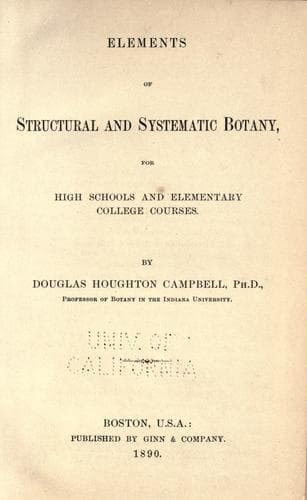
Elements of Structural and Systematic Botany: For High Schools and Elementary College CoursesCampbell, Douglas Houghton
Science
Elements of Structural and Systematic Botany: For High Schools and Elementary College Courses
Campbell, Douglas Houghton
Botany -- Textbooks
in these so-called "ray-flowers." In the third group, of which the
dandelion (Fig. 125, _H_), chicory, lettuce, etc., are examples, all
of the flowers have strap-shaped, split corollas, and contain both
stamens and pistils.
The families of the _Aggregatæ_ are the following: I. _Rubiaceæ_ of
which _Houstonia_ (Fig. 124, _A_), _Galium_ (_E_), _Cephalanthus_
(button-bush), and _Mitchella_ (partridge-berry) are examples;
II. _Caprifoliaceæ_, containing the honeysuckles (_Lonicera_)
(Fig. 124, _I_), _Viburnum_ (_G_), snowberry (_Symphoricarpus_), and
elder (_Sambucus_); III. _Valerianeæ_, represented by the common
valerian (_Valeriana_) (Fig. 124, _L_); IV. _Dipsaceæ_, of which the
teasel (_Dipsacus_) (Fig. 124, _P_), is the type, and also species of
scabious (_Scabiosa_); V. _Compositæ_ to which the innumerable,
so-called compound flowers, asters, golden-rods, daisies, sunflowers,
etc. belong; VI. _Calycereæ_.
[Illustration: FIG. 126.--_Aristolochiaceæ_. _A_, plant of wild ginger
(_Asarum_), × ⅓. _B_, vertical section of the flower, × 1. _C_,
diagram of the flower.]
Besides the groups already mentioned, there are several families of
dicotyledons whose affinities are very doubtful. They are largely
parasitic, _e.g._ mistletoe; or water plants, as the horned pond-weed
(_Ceratophyllum_). One family, the _Aristolochiaceæ_, represented by
the curious "Dutchman's pipe" (_Aristolochia sipho_), a woody twiner
with very large leaves, and the common wild ginger (_Asarum_)
(Fig. 126), do not appear to be in any wise parasitic, but the
structure of their curious flowers differs widely from any other group
of plants.
CHAPTER XX.
FERTILIZATION OF FLOWERS.
If we compare the flowers of different plants, we shall find almost
infinite variety in structure, and this variation at first appears to
follow no fixed laws; but as we study the matter more thoroughly, we
find that these variations have a deep significance, and almost
without exception have to do with the fertilization of the flower.
In the simpler flowers, such as those of a grass, sedge, or rush among
the monocotyledons, or an oak, hazel, or plantain, among dicotyledons,
the flowers are extremely inconspicuous and often reduced to the
simplest form. In such plants, the pollen is conveyed from the male
flowers to the female by the wind, and to this end the former are
usually placed above the latter so that these are dusted with the
pollen whenever the plant is shaken by the wind. In these plants, the
male flowers often outnumber the female enormously, and the pollen is
produced in great quantities, and the stigmas are long and often
feathery, so as to catch the pollen readily. This is very beautifully
shown in many grasses.
Public-domain text, read in full here on John Shaqi.
Reviews
Reviews
No reviews yet
Be the first to share your thoughts on this work.
Elsewhere in the archive
Join the Discussion
Join the discussion
Sign in to leave a comment or review.
Sign InorCreate an account