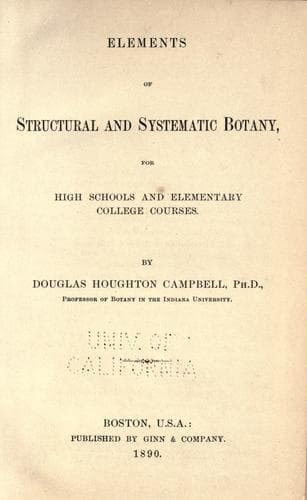
Elements of Structural and Systematic Botany: For High Schools and Elementary College CoursesCampbell, Douglas Houghton
Science
Elements of Structural and Systematic Botany: For High Schools and Elementary College Courses
Campbell, Douglas Houghton
Botany -- Textbooks
The sterile branches (_B_) are more slender than the spore-bearing
ones, and the sheaths shorter. Surrounding the joints, apparently just
below the sheaths, but really breaking through their bases, are
circles of slender branches resembling the main branch, but more
slender. The sterile branches grow to a height of forty to fifty
centimetres, and from their bushy form the popular name of the plant,
"horse-tail," is taken. The surface of the plant is hard and rough,
due to the presence of great quantities of flint in the epidermis,--a
peculiarity common to all the species.
The stem is mainly composed of large, thin-walled cells, becoming
smaller as they approach the epidermis. The outer cells of the
ground tissue in the green branches contain chlorophyll, and the
walls of some of them are thickened. The fibro-vascular bundles
differ entirely from those of the ferns. Each bundle is nearly
triangular in section (_E_), with the point inward, and the inner
end occupied by a large air space. The tracheary tissue is only
slightly developed, being represented by a few vessels[9] (_tr._) at
the outer angles of the bundle, and one or two smaller ones close to
the air channel. The rest of the bundle is made up of nearly
uniform, rather thin-walled, colorless cells, some of which,
however, are larger, and have perforated cross-walls, representing
the sieve tubes of the fern bundle. There is no individual bundle
sheath, but the whole circle of bundles has a common outer sheath.
[9] A vessel differs from a tracheid in being composed of several
cells placed end to end, the partitions being wholly or partially
absorbed, so as to throw the cells into close communication.
The epidermis is composed of elongated cells whose walls present a
peculiar beaded appearance, due to the deposition of flint within
them. The breathing pores are arranged in vertical lines, and
resemble in general appearance those of the ferns, though differing
in some minor details. Like the other epidermal cells the guard
cells have heavy deposits of flint, which here are in the form of
thick transverse bars.
The spore cases have thin walls whose cells, shortly before
maturity, develop thickenings upon their walls, which have to do
with the opening of the spore case. The spores (_H_, _I_) are round
cells containing much chlorophyll and provided with four peculiar
appendages called elaters. The elaters are extremely sensitive to
changes in moisture, coiling up tightly when moistened (_I_), but
quickly springing out again when dry (_H_). By dusting a few dry
spores upon a slide, and putting it under the microscope without any
water, the movement may be easily examined. Lightly breathing upon
them will cause the elaters to contract, but in a moment, as soon as
the moisture of the breath has evaporated, they will uncoil with a
quick jerk, causing the spores to move about considerably.
Public-domain text, read in full here on John Shaqi.
Reviews
Reviews
No reviews yet
Be the first to share your thoughts on this work.
Elsewhere in the archive
Join the Discussion
Join the discussion
Sign in to leave a comment or review.
Sign InorCreate an account