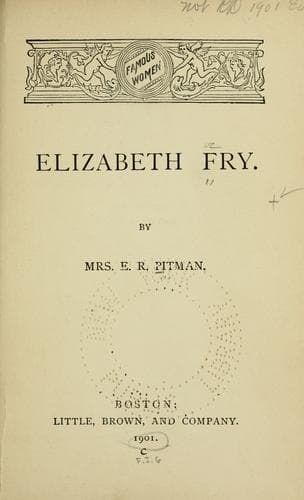
Fry, Elizabeth Gurney, 1780-1845; Prison reformers -- Biography
During her residence there she was subject to distressing attacks of
faintness in the night and early morning. Again and again, it was
necessary to immediately throw open her chamber window for the admission
of the fresh air; and always upon such occasions the figure of a
solitary coast-guardsman was to be seen pacing the beach, on the
look-out for smugglers. Such a post, and such a service, presenting as
it did a life of hardship and danger, inevitably attracted her
sympathetic attention; and she began to take an almost unconscious
interest in the affairs of this man. Shortly after, when driving out,
she stopped the carriage and spoke to one of the men at the station. He
replied civilly, that the members of the Preventive Service were not
allowed to hold any conversation with strangers, and requested to be
excused from saying any more. Mrs. Fry, feeling somewhat fearful that
her kindness might bring him into difficulty with his superiors, gave
the man her card, and desired him to tell the man in command of the
station that she had spoken to him with the sole object of inquiring
after the welfare of the men and their families. A few days afterwards,
the lieutenant who commanded at that post waited upon Mrs. Fry, and,
contrary to her fears, welcomed her inquiries as auguries of good. He
confessed to her that the officers, men, women, and children, all
suffered much from loneliness, privation, semi-banishment--for the
stations were mostly placed in dreary and inaccessible
places--unpopularity with the surrounding people, and harassment by
constant watching, through all weather, for smugglers. The nature and
regulations of the Coast Blockade of Preventive Service precluded
anything like visiting or _personal_ kindness. There was really no way
of benefiting them except by providing them with literature calculated
to promote their intellectual and religious good, besides furnishing an
occupation for the dreary, lonely hours which fell to their portion.
This course Mrs. Fry immediately adopted.
She first applied to the British and Foreign Bible Society; the
Committee responded with a grant of fifty Bibles and twenty-five
Testaments. These were distributed to the men on the stations in that
district, and most gratefully received. As a proof of the gratitude of
the recipients, the following little note was sent to Mrs. Fry by the
commanding officer:--
Public-domain text, read in full here on John Shaqi.
Reviews
Reviews
No reviews yet
Be the first to share your thoughts on this work.
Elsewhere in the archive
Join the Discussion
Join the discussion
Sign in to leave a comment or review.
Sign InorCreate an account