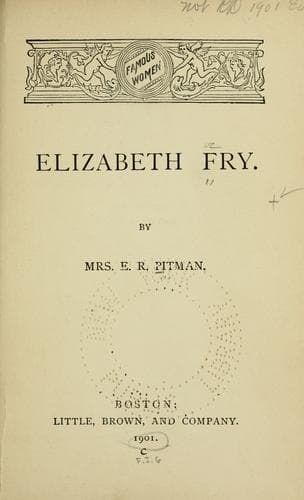
Fry, Elizabeth Gurney, 1780-1845; Prison reformers -- Biography
The following letter was from a convict at Paramatta, New South Wales,
some time after her banishment to that colony:--
HONORED MADAM,--The duty I owe to you, likewise to the benevolent
society to which you have the honor to belong, compels me to take
up my pen to return you my most sincere thanks for the heavenly
instruction I derived from you, and the dear friends, during my
confinement in Newgate.
In the month of April, 1817, that blessed prayer of yours sank deep
into my heart; and as you said, so I have found it, that when no
eyes see and no ears hear, God both sees and hears, and then it was
that the arrow of conviction entered my hard heart; in Newgate it
was that poor Harriet, like the Prodigal Son, came to herself, and
took with her words, and sought the Lord. Truly I can say with
David, "Before I was afflicted I went astray, but now I have
learned Thy ways, O Lord."... Believe me, my dear Madam, I bless
the day that brought me inside Newgate walls, for then it was that
the ways of Divine truth shone into my dark mind.'... Believe me,
my dear Madam, although I am a poor captive in a distant land, I
would not give up having communion with God one single day for my
liberty; for what is the liberty of the body compared with the
liberty of the soul? Soon will the time come when death will
release me from all the earthly fetters that hold me now, for I
trust to be with Christ, who bought me with His precious blood. And
now, my dear Madam, these few sincere sentiments of mine I wish you
to make known to the world, that the world may see that your labor
in Newgate has not been in vain in the Lord. Please give my love to
the dear friends; the keeper of Newgate, and all the afflicted
prisoners; and although we may never meet on earth again, I hope we
shall all meet in the realms of bliss, never to part again.
Believe me to remain your humble servant,
HARRIET S----.
In addition to the grateful acknowledgments of "those who were ready to
perish," Mrs. Fry won an unusual meed of honorable esteem from the noble
and great. Sovereigns and rulers, statesmen and cabinet councillors, all
owned the worth of goodness, and rendered to the Quaker lady the homage
of both tongue and heart. Beside that notable visit to the Mansion House
to be presented to Queen Charlotte, in 1818, Mrs. Fry had many
interviews with royalty--these royal and noble personages conferring
honor upon themselves more than upon her by their kindly interest in her
work.
Public-domain text, read in full here on John Shaqi.
Reviews
Reviews
No reviews yet
Be the first to share your thoughts on this work.
Elsewhere in the archive
Join the Discussion
Join the discussion
Sign in to leave a comment or review.
Sign InorCreate an account