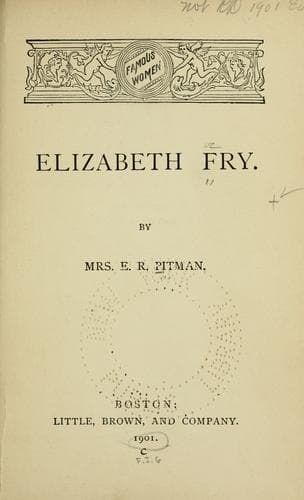
Fry, Elizabeth Gurney, 1780-1845; Prison reformers -- Biography
Honors clustered thickly about her declining days. She was the welcomed
guest of royalty and nobility; on the Continent, as well as in far-away
English colonies, her name was pronounced only with respectful love. Her
eldest son was appointed to the magistracy of the county; her relatives
and associates were foremost in every enterprise intended to benefit
mankind; while both in Parliament and out of it, her recommendations
were respectfully adopted. Had her years been counted on the patriarchal
scale, instead of by their own shortened number, she could have reaped
no higher honors; for titles were in her ears but empty sounds, and
wealth only meant increased responsibility. Not many nobler souls walked
this earth, either in Quaker garb or out of it.
In 1842 her state of health appeared to be so infirm and shattered that
her brother-in-law, Mr. Hoare, offered her the loan of his house at
Cromer. She accepted the offer for a couple of months, and found a
little benefit for the bracing air. She mentioned in her diary at this
time that she had "an undue fear of an imbecile or childish state"--a
not unlikely feeling to be cherished by an energetic woman accustomed
all her life long to the work of helping others. At the end of October
she returned home, thankfully rejoicing, however, in an improved state
of health.
But a new series of trials awaited her. Death seemed to visit the happy
family circle so often that one wonders almost where the tale will stop.
Four or five grand-children passed away in rapid succession. After the
funeral of the first grand-child, she assembled the family party in the
evening, and with a little of the old fire and yearning affection, gave
them exhortation and consolation. Then she prayed for all the members of
the three generations present. After this funeral service she paid a
final visit to France; and then returned home, to descend still further
into the valley of suffering.
Her sister-in-law--also named Elizabeth Fry--died during this time of
weakness and pain. There had been a close bond of sympathy between these
two women; they had travelled many times together as ministers in the
Society of Friends, and had been united by the closest bonds of womanly
and Christian affection. The faithful sister-in-law preceded the
philanthropist to "the better land," by about fifteen months.
Public-domain text, read in full here on John Shaqi.
Reviews
Reviews
No reviews yet
Be the first to share your thoughts on this work.
Elsewhere in the archive
Join the Discussion
Join the discussion
Sign in to leave a comment or review.
Sign InorCreate an account