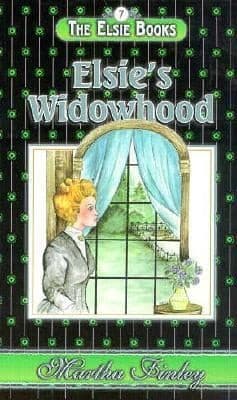
Elsie's Widowhood: A Sequel to Elsie's ChildrenFinley, Martha
General
Elsie's Widowhood: A Sequel to Elsie's Children
Finley, Martha
Christian life -- Juvenile fiction; Dinsmore, Elsie (Fictitious character) -- Juvenile fiction; Domestic fiction; Religious fiction
"I was out for an hour this morning."
"An hour! and the weather is so delightful, everything out of doors
looking so lovely, that the rest of us find it next to impossible to
content ourselves within doors for an hour. Some of us are going to play
croquet. If you will not drive, won't you let one of the servants wheel
you out there--near enough to enable you to watch the game?"
"Please don't think me ungracious," Molly answered, coloring, "but I
really should prefer to stay here and work."
"I think Aunt Enna is going with us, and you will be left quite alone,
unless you will let me stay, or send a servant to sit with you," Elsie
suggested.
But Molly insisted that she would rather be alone. "And you know," she
added, pointing to a silver hand bell on the table before her, "I can
ring if I need anything."
So Elsie went rather sadly away, more than half suspecting that Molly
was grieving over her inability to move about as others did, and take
part in the active sports they found so enjoyable and healthful.
And indeed she had hardly closed the door between them when the tears
began to roll down Molly's cheeks. She wiped them away and tried to go
on with her work; but they came faster and faster, till throwing down
her pen she hid her face in her hands, and burst into passionate
weeping, sobs shaking her whole frame.
A longing so intense had come over her to leave that chair, to walk, to
run, to leap and dance, as she had delighted to do in the old days
before that terrible fall. She wanted to wander over the velvety lawn
beneath her windows, to pluck for herself the many-hued, sweet-scented
flowers, growing here and there in the grass. Kind hands were always
ready to gather and bring them to her, but it was not like walking about
among them, stooping down and plucking them with her own fingers.
Oh to feel her feet under her and wander at her own sweet will about the
beautiful grounds, over the hills and through the woods! Oh to feel that
she was a fit mate for some one who might some day love and cherish her
as Mr. Travilla had loved and cherished her whom he so fondly called his
"little wife!"
She pitied her cousin for her sad bereavement; her heart had often,
often bled for her because of her loss; but ah! it were "better to have
loved and lost, than never to have loved at all."
Never to love, never to be loved, that was the hardest part of it all.
There was Dick, to be sure, the dear fellow! how she did love him! and
she believed he loved her almost as well; but the time would come when
another would have the first place in his heart; perhaps it had already
come.
Her mother's affection was something, but it was the love of a stronger
nature than her own that she craved, a staff to lean upon, a guiding,
protecting love, a support such as is the strong, stately oak to the
delicate, clinging vine.
Public-domain text, read in full here on John Shaqi.
Reviews
Reviews
No reviews yet
Be the first to share your thoughts on this work.
Elsewhere in the archive
Join the Discussion
Join the discussion
Sign in to leave a comment or review.
Sign InorCreate an account