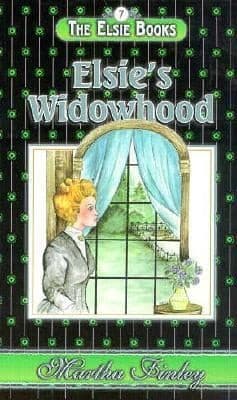
Elsie's Widowhood: A Sequel to Elsie's ChildrenFinley, Martha
General
Elsie's Widowhood: A Sequel to Elsie's Children
Finley, Martha
Christian life -- Juvenile fiction; Dinsmore, Elsie (Fictitious character) -- Juvenile fiction; Domestic fiction; Religious fiction
"How like you that is, papa dear," Elsie said; "but it would be easier
to me to bear blame myself than to have it heaped upon you. I suppose,
though, that it would be useless to attempt any interference with the
course of true love?"
"Yes; we will simply let them alone."
Mr. Dinsmore rode over to Magnolia Hall that afternoon to seek an
interview with its owner; but learned that he was not at home, and might
not be for a day or two. No one knew just when he would return. So the
only course now left seemed to be to wait till he should call again at
Viamede.
He had been an almost daily visitor of late, and often sent some token
of remembrance by a servant--fruit, flowers, game or fish, or it might
be a book from his library which was not found in theirs.
But now one, two, three days passed and nothing was seen or heard of
him.
Sad, wearisome days they were to Molly: mental labor was next to
impossible; she could not even read with any enjoyment; her heart was
heavy with grief and unsatisfied longing, intensified by her mother's
constant reiteration, "You've offended him, and he'll never come again;
you've thrown away the best chance a girl ever had; and you'll never
see another like it."
Then it was unusually long since she had heard from Dick; and she had
waited for news from a manuscript which had cost her months of hard
work, and on which great expectations were based, till her heart was
sick with hope deferred.
It was on the morning of the fourth day that Molly, having persuaded her
mother to go for a walk with her grandfather and Mrs. Carrington,
summoned a servant and desired to be taken out into the grounds.
She sat motionless in her chair gazing in mournful silence on all the
luxuriant beauty that surrounded her, while the man wheeled her up one
walk and down another.
At length, "That will do, Joe," she said; "you may stop the chair under
that magnolia yonder, and leave me there for an hour."
"I'se 'fraid you git tired, Miss Molly, and nobody roun' for to wait on
you," he remarked when he had placed her in the desired spot.
"No; I have the bell here, and it can be heard at the house. I have a
book, too, to amuse myself with: and the gardener yonder is within
sight. You need not fear to leave me."
He walked away and she opened her book. But she scarcely looked at it.
Her thoughts were busying themselves with something else, and her eyes
were full of tears.
A quick, manly step on the gravel walk behind her startled her and sent
a vivid color over face and neck.
"Good morning, Miss Percival; I am fortunate indeed in finding you here
alone," a voice said, close at her side.
"Good morning, Mr. Embury," she returned, with a vain effort to steady
her tones, and without looking up.
He took possession of a rustic seat close to which her chair was
standing. "Molly, my dear Miss Molly," he said, in some agitation, "I
fear I have unwittingly offended."
Public-domain text, read in full here on John Shaqi.
Reviews
Reviews
No reviews yet
Be the first to share your thoughts on this work.
Elsewhere in the archive
Join the Discussion
Join the discussion
Sign in to leave a comment or review.
Sign InorCreate an account