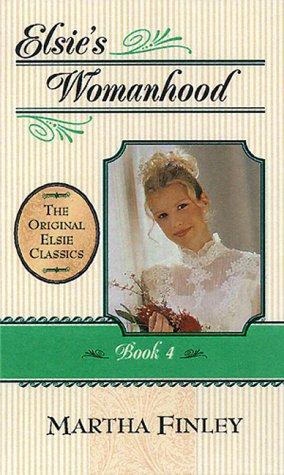
Christian life -- Juvenile fiction; Dinsmore, Elsie (Fictitious character) -- Juvenile fiction; Domestic fiction; Religious fiction
"I will try to follow out your wishes, papa. Edward has said the same
thing to me, and no doubt you are right; but it is so sweet to have her in
my arms, and so hard to refuse when she asks to be taken up."
"You mustn't ask mamma to carry you," Mr. Dinsmore said to the child,
caressing her tenderly as he spoke; "poor mamma is not strong, and you
will make her sick."
They had seated themselves side by side upon a sofa. The little one turned
a piteous look upon her mother, and with a quivering lip and fast-filling
eyes, said, "Mamma sick? Elsie tiss her, make her well?"
"No, my precious pet, mother isn't sick; so don't cry," Elsie answered,
receiving the offered kiss, as the babe left her grandfather's knee and
crept to her; then the soft little hands patted her on the cheeks and the
chubby arms clung about her neck.
But catching sight, through the open window, of her father coming up the
garden walk, wee Elsie hastily let go her hold, slid to the floor and ran
to meet him.
Mr. Dinsmore seemed again lost in gloomy thought.
"Papa, dear, what is it? What troubles you so?" asked Elsie, moving closer
to him, and leaning affectionately on his shoulder, while the soft eyes
sought his with a wistful, anxious expression.
He put his arm about her, and just touching her cheek with his lips,
heaved a deep sigh. "The papers bring us bad news. Lincoln is elected."
"Ah well, let us not borrow trouble, papa; perhaps he may prove a pretty
good president after all."
"Just what I think," remarked Mr. Travilla, who had come in with his
little girl in his arms at the moment of Mr. Dinsmore's announcement, and
seated himself on his wife's other side; "let us wait and see. All may go
right with our country yet."
Mr. Dinsmore shook his head sadly. "I wish I could think so, but in the
past history of all republics whenever section has arrayed itself against
section the result has been either a peaceful separation, or civil war;
nor can we hope to be an exception to the rule."
"I should mourn over either," said Elsie, "I cannot bear to contemplate
the dismemberment of our great, glorious old Union. Foreign nations would
never respect either portion as they do the undivided whole."
"No; and I can't believe either section can be so mad as to go that
length," remarked her husband, fondling his baby daughter as he spoke.
"The North, of course, does not desire a separation; but if the South
goes, will be pretty sure to let her go peaceably."
"I doubt it, Travilla; and even if a peaceable separation should be
allowed at first, so many causes of contention would result (such as the
control of the navigation of the Mississippi, the refusal of the North to
restore runaway negroes, etc., etc.), that it would soon come to blows."
"Horace, you frighten me," said Rose, who had come in while they were
talking.
The color faded from Elsie's cheek, and a shudder ran over her, as she
turned eagerly to hear her husband reply.
Public-domain text, read in full here on John Shaqi.
Reviews
Reviews
No reviews yet
Be the first to share your thoughts on this work.
Elsewhere in the archive
Join the Discussion
Join the discussion
Sign in to leave a comment or review.
Sign InorCreate an account