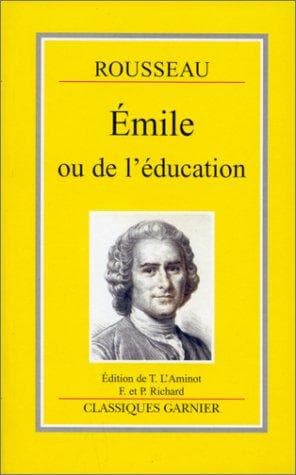
Undoubtedly the notions of things thus acquired for oneself
are clearer and much more convincing than those acquired from the
teaching of others; and not only is our reason not accustomed to a
slavish submission to authority, but we develop greater ingenuity
in discovering relations, connecting ideas and inventing apparatus,
than when we merely accept what is given us and allow our minds to
be enfeebled by indifference, like the body of a man whose servants
always wait on him, dress him and put on his shoes, whose horse
carries him, till he loses the use of his limbs. Boileau used to
boast that he had taught Racine the art of rhyming with difficulty.
Among the many short cuts to science, we badly need some one to
teach us the art of learning with difficulty.
The most obvious advantage of these slow and laborious inquiries
is this: the scholar, while engaged in speculative studies, is
actively using his body, gaining suppleness of limb, and training
his hands to labour so that he will be able to make them useful
when he is a man. Too much apparatus, designed to guide us in our
experiments and to supplement the exactness of our senses, makes
us neglect to use those senses. The theodolite makes it unnecessary
to estimate the size of angles; the eye which used to judge distances
with much precision, trusts to the chain for its measurements; the
steel yard dispenses with the need of judging weight by the hand
as I used to do. The more ingenious our apparatus, the coarser and
more unskilful are our senses. We surround ourselves with tools
and fail to use those with which nature has provided every one of
us.
But when we devote to the making of these instruments the skill
which did instead of them, when for their construction we use the
intelligence which enabled us to dispense with them, this is gain
not loss, we add art to nature, we gain ingenuity without loss of
skill. If instead of making a child stick to his books I employ
him in a workshop, his hands work for the development of his mind.
While he fancies himself a workman he is becoming a philosopher.
Moreover, this exercise has other advantages of which I shall speak
later; and you will see how, through philosophy in sport, one may
rise to the real duties of man.
I have said already that purely theoretical science is hardly
suitable for children, even for children approaching adolescence;
but without going far into theoretical physics, take care that all
their experiments are connected together by some chain of reasoning,
so that they may follow an orderly sequence in the mind, and may
be recalled at need; for it is very difficult to remember isolated
facts or arguments, when there is no cue for their recall.
Public-domain text, read in full here on John Shaqi.
Reviews
Reviews
No reviews yet
Be the first to share your thoughts on this work.
Elsewhere in the archive
Join the Discussion
Join the discussion
Sign in to leave a comment or review.
Sign InorCreate an account