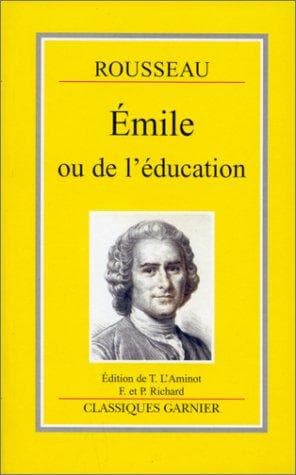
Let the child do nothing because he is told; nothing is good for
him but what he recognises as good. When you are always urging him
beyond his present understanding, you think you are exercising a
foresight which you really lack. To provide him with useless tools
which he may never require, you deprive him of man's most useful
tool--common-sense. You would have him docile as a child; he will
be a credulous dupe when he grows up. You are always saying, "What
I ask is for your good, though you cannot understand it. What does
it matter to me whether you do it or not; my efforts are entirely
on your account." All these fine speeches with which you hope to
make him good, are preparing the way, so that the visionary, the
tempter, the charlatan, the rascal, and every kind of fool may
catch him in his snare or draw him into his folly.
A man must know many things which seem useless to a child, but
need the child learn, or can he indeed learn, all that the man must
know? Try to teach the child what is of use to a child and you
will find that it takes all his time. Why urge him to the studies
of an age he may never reach, to the neglect of those studies which
meet his present needs? "But," you ask, "will it not be too late
to learn what he ought to know when the time comes to use it?"
I cannot tell; but this I do know, it is impossible to teach it
sooner, for our real teachers are experience and emotion, and man
will never learn what befits a man except under its own conditions.
A child knows he must become a man; all the ideas he may have as
to man's estate are so many opportunities for his instruction, but
he should remain in complete ignorance of those ideas which are
beyond his grasp. My whole book is one continued argument in support
of this fundamental principle of education.
As soon as we have contrived to give our pupil an idea of the
word "Useful," we have got an additional means of controlling him,
for this word makes a great impression on him, provided that its
meaning for him is a meaning relative to his own age, and provided
he clearly sees its relation to his own well-being. This word makes
no impression on your scholars because you have taken no pains to
give it a meaning they can understand, and because other people
always undertake to supply their needs so that they never require
to think for themselves, and do not know what utility is.
Public-domain text, read in full here on John Shaqi.
Reviews
Reviews
No reviews yet
Be the first to share your thoughts on this work.
Elsewhere in the archive
Join the Discussion
Join the discussion
Sign in to leave a comment or review.
Sign InorCreate an account