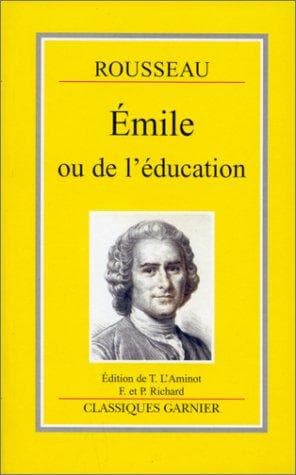
We have come back to ourselves. Having entered into possession of
himself, our child is now ready to cease to be a child. He is more
than ever conscious of the necessity which makes him dependent on
things. After exercising his body and his senses you have exercised
his mind and his judgment. Finally we have joined together the
use of his limbs and his faculties. We have made him a worker and
a thinker; we have now to make him loving and tender-hearted, to
perfect reason through feeling. But before we enter on this new
order of things, let us cast an eye over the stage we are leaving
behind us, and perceive as clearly as we can how far we have got.
At first our pupil had merely sensations, now he has ideas; he
could only feel, now he reasons. For from the comparison of many
successive or simultaneous sensations and the judgment arrived
at with regard to them, there springs a sort of mixed or complex
sensation which I call an idea.
The way in which ideas are formed gives a character to the human
mind. The mind which derives its ideas from real relations is
thorough; the mind which relies on apparent relations is superficial.
He who sees relations as they are has an exact mind; he who fails
to estimate them aright has an inaccurate mind; he who concocts
imaginary relations, which have no real existence, is a madman; he
who does not perceive any relation at all is an imbecile. Clever
men are distinguished from others by their greater or less aptitude
for the comparison of ideas and the discovery of relations between
them.
Simple ideas consist merely of sensations compared one with another.
Simple sensations involve judgments, as do the complex sensations
which I call simple ideas. In the sensation the judgment is purely
passive; it affirms that I feel what I feel. In the percept or idea
the judgment is active; it connects, compares, it discriminates
between relations not perceived by the senses. That is the whole
difference; but it is a great difference. Nature never deceives
us; we deceive ourselves.
I see some one giving an ice-cream to an eight-year-old child; he
does not know what it is and puts the spoon in his mouth. Struck
by the cold he cries out, "Oh, it burns!" He feels a very keen
sensation, and the heat of the fire is the keenest sensation he
knows, so he thinks that is what he feels. Yet he is mistaken; cold
hurts, but it does not burn; and these two sensations are different,
for persons with more experience do not confuse them. So it is not
the sensation that is wrong, but the judgment formed with regard
to it.
Public-domain text, read in full here on John Shaqi.
Reviews
Reviews
No reviews yet
Be the first to share your thoughts on this work.
Elsewhere in the archive
Join the Discussion
Join the discussion
Sign in to leave a comment or review.
Sign InorCreate an account