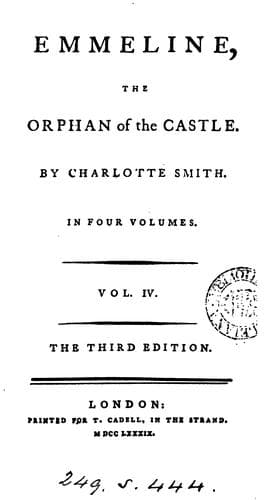
Emmeline, the Orphan of the CastleSmith, Charlotte
General
Emmeline, the Orphan of the Castle
Smith, Charlotte
Gothic fiction; Great Britain -- Social life and customs -- 18th century -- Fiction; Marriage -- Fiction; Single women -- Fiction
I have the honour to be,
my Lord,
your Lordship's
most obedient servant,
EMMELINE MOWBRAY.'
_Clapham, Dec. 3._
Lord Montreville received this letter in her Ladyship's dressing-room.
The servant who brought it in, said it came from Clapham; and Lady
Montreville insisted on seeing its contents. She had been before
acquainted with what had passed; and bestowed on her son the severest
invectives for his obstinacy and folly. Poor Emmeline however, who was
the cause of it, was the principal object of her resentment and disdain.
Even this last instance of her rectitude, could not diminish the
prejudice which embittered the mind of Lady Montreville against her. She
lamented, whenever she deigned to speak of her, that the laws of this
country, unlike those of better regulated kingdoms, did not give people
of fashion power to remove effectually those who interfered with their
happiness, or were inimical to their views. 'If this little wretch,'
said she, 'was in France, it would not be difficult to put an end to the
trouble she has dared to give us. A _letter de cachet_ would cure the
creature of her presumption, and place her where her art and affectation
should not disturb the peace of families of high rank.'
Lord Montreville heard these invectives without reply, but not without
pain.
Augusta Delamere, who arrived in Berkley-square the same morning that
Lady Montreville did, felt still more hurt by her mother's determined
hatred to Emmeline, whom she languished to see, and had never ceased to
love.
Miss Delamere inheriting all the pride of her mother, and adding to it a
sufficient share of vanity and affectation of her own, had taken a
dislike to the persecuted Emmeline, if possible more inveterate than
that of Lady Montreville. Tho' she had never seen her, she detested her;
and exerted all her influence on her mother to prevent her being
received into the family as her father's relation. Fitz-Edward had
praised her as the most interesting woman he had ever seen. Miss
Delamere had no aversion to Fitz-Edward; and tho' he had never seemed
sensible of the honour she did him, she could not divest herself wholly
of that partiality towards him, which made her heartily abhor any woman
he seemed to admire. When to this cause of dislike was added, what she
called the insolent presumption of the animal in daring to attempt
inveigling _her_ brother into the folly of marrying, she thought she
might indulge all the rancour, envy, and malignity of her heart.
When Lady Montreville had read the letter, she threw it down on the
table contemptuously.
'It requires no answer,' said she to the servant who waited.
The man left the room.
Public-domain text, read in full here on John Shaqi.
Reviews
Reviews
No reviews yet
Be the first to share your thoughts on this work.
Elsewhere in the archive
Join the Discussion
Join the discussion
Sign in to leave a comment or review.
Sign InorCreate an account