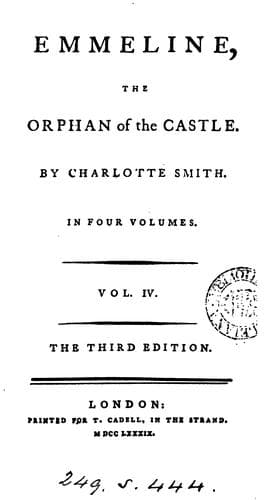
Emmeline, the Orphan of the CastleSmith, Charlotte
General
Emmeline, the Orphan of the Castle
Smith, Charlotte
Gothic fiction; Great Britain -- Social life and customs -- 18th century -- Fiction; Marriage -- Fiction; Single women -- Fiction
Fitz-Edward, a most perfect judge of female hearts, made his
observations on all this, with which he knew he should most effectually
gratify his friend; and in his insinuating way, he said all he could
think of to encrease her compassion for her lover, and inflame her
resentment against those who impeded a union, which he was pretty sure
Emmeline now wished for, as well as Delamere.
CHAPTER III
When they arrived at Clapham, Emmeline found Mrs. Ashwood was not yet
returned. Fitz-Edward entreated her to sing to him; and either was, or
pretended to be, in raptures at her improvement since they had met in
the summer.
About half an hour after four, Mrs. Ashwood came in; and throwing open
the parlour door, asked Emmeline, in no very sweet accent, 'Why she had
given her the trouble to go in her carriage to Berkley-square, if she
intended going home by any other conveyance?'
Mrs. Ashwood was subject to causeless fits of ill-humour, to which
Emmeline was a good deal accustomed; and concluding she was now seized
with some sudden discomposure of temper, mildly answered, 'That she
supposed there had been a mistake; for that the chariot did not come for
her at the appointed time.'
'Mistake!' replied the other lady, sharply; 'I don't know as to mistake;
but if you had chosen it, you might have staid dinner with Lady
Montreville.'
Emmeline, without seeming to attend to the asperity of the address,
desired to introduce Colonel Fitz-Edward.
As this short dialogue had passed without Mrs. Ashwood's having entered
the room, she had not seen the stranger, who now advanced towards her.
The title of Colonel, added to his military air and handsome figure,
seemed to gain at once her favourable opinion; and her countenance
losing the unpleasing expression of ill-temper, immediately put on its
best smile, and an affectation of softness and complacency with which
she frequently adorned it.
She seemed to consider the handsome young soldier as a conquest worthy
all her ambition; and finding he was the most intimate friend of
Delamere, had no apprehension that his admiration would be diverted by
the youth and attractions of Emmeline.
Fitz-Edward presently understood her character; and with admirable
adroitness acted the part of a man afraid of being too much charmed. He
cast an arch look at Emmeline; then made to the Lady of the house some
compliments so extravagant, that only the weakest vanity could prevent
her seeing its ridicule. But Fitz-Edward, who found in a moment that
nothing was too gross to be believed, fearlessly repeated the dose; and
before dinner came in, she was in the best humour imaginable, and
pressed him so earnestly to partake of it, that, after an apology for
sitting down in his morning dishabille, he consented.
Public-domain text, read in full here on John Shaqi.
Reviews
Reviews
No reviews yet
Be the first to share your thoughts on this work.
Elsewhere in the archive
Join the Discussion
Join the discussion
Sign in to leave a comment or review.
Sign InorCreate an account