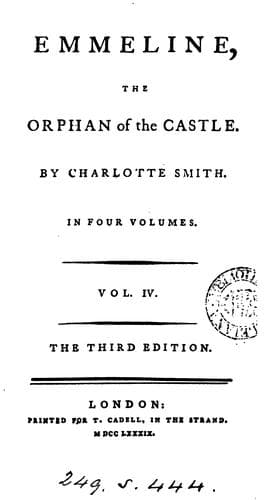
Emmeline, the Orphan of the CastleSmith, Charlotte
General
Emmeline, the Orphan of the Castle
Smith, Charlotte
Gothic fiction; Great Britain -- Social life and customs -- 18th century -- Fiction; Marriage -- Fiction; Single women -- Fiction
her knowing no better, I shall countenance her, and so will my Lord."
This was, as near as I remember, Emmeline, what my Lady said to me. You
know [_the milk of roses is almost out_] you know I could not refuse to
tell her I would certainly talk to you. I was surprised to find her
Ladyship so obliging and affable, as you had told me she is reckoned so
very proud. She ordered her gentleman to give me a ticket for a rout and
a supper her Ladyship gives on Tuesday three weeks; and she said, that
as she did not doubt but that you would discover your own interest by
that time, I should take one for you. Look you, here it is.'
'I shall be in Dorsetshire, I hope, long before Tuesday se'nnight,' said
Emmeline, laying the card coolly on the toilet. She found Mrs. Ashwood
had nothing more material to say; and being apprehensive that she
impeded the last finish which her dress and person required, she thanked
her, and went back into her own room.
The eagerness and resolution with which Lady Montreville opposed her
son's marriage, appeared from nothing more evidently, than from her thus
endeavouring to solicit the assistance of Mrs. Ashwood, and humbling
herself to use flattery and insinuation towards a person to whom it is
probable nothing else could have induced her to speak. With persons in
trade, or their connections, or even with gentlemen, unless of very
ancient and honourable families, she seldom deigned to hold any
communication; and if she had occasion to speak to them individually, it
was generally under the appellation of 'Mr. or Mrs. I forget the name;'
for to remember the particular distinctions of such inferior beings, was
a task too heavy for Right Honourable intellects. When she spoke of such
collectively, it was under the denomination of 'the people, or the
folks.'
With that sort of condescension that seems to say, 'I will humble myself
to your level,' and which is in fact more insolent than the most
offensive haughtiness, her Ladyship had behaved to Mrs. Ashwood; who
took it for extreme politeness, and was charmed on any terms to obtain
admission to the house of a woman of such high fashion, and who was
known to be so very nice in the choice of her company.
Public-domain text, read in full here on John Shaqi.
Reviews
Reviews
No reviews yet
Be the first to share your thoughts on this work.
Elsewhere in the archive
Join the Discussion
Join the discussion
Sign in to leave a comment or review.
Sign InorCreate an account