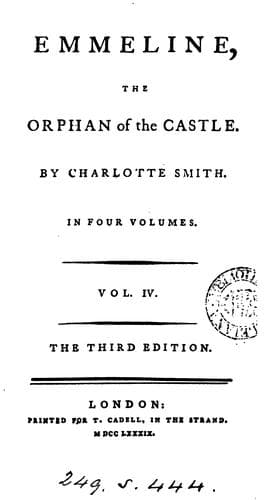
Emmeline, the Orphan of the CastleSmith, Charlotte
General
Emmeline, the Orphan of the Castle
Smith, Charlotte
Gothic fiction; Great Britain -- Social life and customs -- 18th century -- Fiction; Marriage -- Fiction; Single women -- Fiction
'There is a door from the garden into the stable-yard, which opens
into the fields. As I cannot come to the house (where I find there
are people who would inform Lord Montreville that I am still about
London,) for pity's sake come down to that door and speak to me. I
ask only _one_ moment; surely you will not deny me so small a
favour, and add to the anguish which consumes me. I write this from
the neighbouring public-house, and wait your answer.
F. DELAMERE.'
Emmeline shuddered at this note. It was more incoherent than usual, and
seemed to be written with a trembling and uncertain hand. She had left
the card-table to read it, and was alone in the anti-room; where, while
she hesitated over it, Rochely, whose eyes were ever in search of her,
followed her. She saw him not: but wholly occupied by the purport of the
note, he approached close to her unheeded.
'Are you determined, Miss Mowbray,' said he, 'to give me no other answer
than you sent somewhat hastily to Lord Montreville, by my friend Sir
Richard Crofts? May I ask, are you quite determined?'
'Quite, Sir!' replied she, starting, without considering and hardly
knowing what she said; but feeling he was at that moment more odious to
her than ever, she snatched away the hand he attempted to take, and flew
out of the room like a lapwing.
The dismayed lover shook his head, surveyed his cut velvet in the glass,
and stroaked his point ruffles, while he was trying to recollect his
scattered ideas.
Emmeline, who had taken refuge in her bed-chamber, sat there in
breathless uncertainty, and unable to determine what to do about
Delamere. At length, she concluded on desiring Fitz-Edward to go down to
him; but knew not how to speak to the colonel on such a subject before
so many witnesses, nor did she like to send for him out of the room. She
rung for a candle, and wrote on a slip of paper.
'Delamere is waiting at a door which opens into the fields, and insists
upon speaking to me. Pray go down to him, and endeavour to prevail on
him to return to his father. I can think of no other expedient to
prevent his engaging in some rash and improper attempt; therefore I
beseech you to go down.'
When she had written this, she knew not how to deliver it; and for the
first time in her life had recourse to an expedient which bore the
appearance of art and dissimulation. She did not chuse to send it to
Fitz-Edward by a servant; but went down with it herself; and approaching
the table where he was settling his winnings--
'Here, colonel,' said she, 'is the _charade_ you desired me to write out
for you.'
'Oh! read it colonel; pray read it;' cried Mrs. Ashwood, 'I doat upon a
_charade_ of all things in nature.'
Public-domain text, read in full here on John Shaqi.
Reviews
Reviews
No reviews yet
Be the first to share your thoughts on this work.
Elsewhere in the archive
Join the Discussion
Join the discussion
Sign in to leave a comment or review.
Sign InorCreate an account