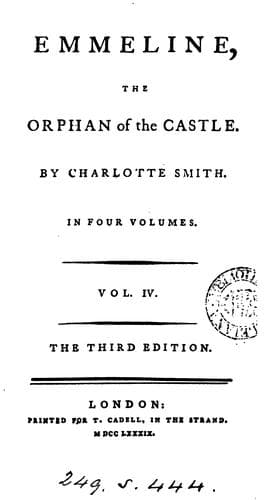
Emmeline, the Orphan of the CastleSmith, Charlotte
General
Emmeline, the Orphan of the Castle
Smith, Charlotte
Gothic fiction; Great Britain -- Social life and customs -- 18th century -- Fiction; Marriage -- Fiction; Single women -- Fiction
Such was his apprehension of the clamours and passions of his wife, that
he could not determine to see her 'till he had at least done all that
was possible to recover her son. He therefore wrote to her a short
letter, stating briefly what had happened, and giving her hopes that he
should be able to overtake the parties before they were married. This he
ordered to be delivered to her in the morning; and directed his servant
to hasten to him with his travelling chaise and four post horses.
The man, however, who had the care of the carriages, believing his Lord
would stay out all night, had gone out also, and taken with him the
keys.
By this delay, and the blunders of the affrighted servants, who in their
haste only impeded each other, it was near nine o'clock before his
Lordship and Sir Richard left London. At Barnet, they heard of the
fugitives, and easily traced them from thence to Hatfield; after which
believing all farther enquiries useless, they passed through Stevenage
(having sent on before for horses,) without asking any questions which
might have led them to discover that Delamere and Emmeline had gone from
thence towards Hertford only an hour and an half before their arrival.
This was fortunate for the pursued; for an enquiry would probably have
led to questions which Mr. Lawson would have found it very difficult to
evade.
Lord Montreville, however, and Sir Richard, hurried on to Buckden; where
being obliged to get out for some refreshment for themselves and their
servants, his Lordship renewed the question--'At what time did a young
gentleman and lady' (describing Delamere and Emmeline) 'pass by?'
The people told him they remembered no such persons about the time he
named.
Lord Montreville then applied at the other houses, and made several
other enquiries; but received only a general assertion that no such
persons had been that way within the last four and twenty hours, or even
within a week.
Sir Richard Crofts, who piqued himself upon his sagacity, told his
Lordship that stupidity, the love of falsehood, or Delamere's bribes,
might occasion this failure of intelligence; but there could be no doubt
of their being gratified with better information when they got to
Stilton. To Stilton therefore they went, but heard exactly the same
answers as they had done at the last stage.
Sir Richard was now again to seek for some plausible conjecture that
might quiet the apprehensive anxiety of Lord Montreville, who guessed
and dreaded he knew not what.
Public-domain text, read in full here on John Shaqi.
Reviews
Reviews
No reviews yet
Be the first to share your thoughts on this work.
Elsewhere in the archive
Join the Discussion
Join the discussion
Sign in to leave a comment or review.
Sign InorCreate an account