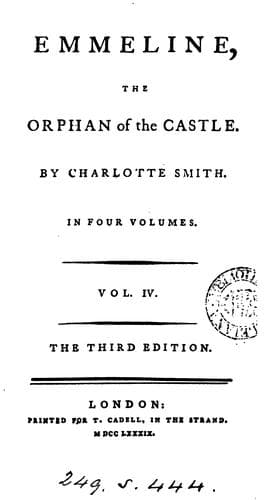
Emmeline, the Orphan of the CastleSmith, Charlotte
General
Emmeline, the Orphan of the Castle
Smith, Charlotte
Gothic fiction; Great Britain -- Social life and customs -- 18th century -- Fiction; Marriage -- Fiction; Single women -- Fiction
Her Ladyship never dreamed that a man of his rank could lift his eyes to
either of her daughters, and therefore encouraged his constant
attendance on them both; while Crofts was too sensible of the value of
such an alliance not to take advantage of the opportunities that were
incessantly afforded him.
Lady Montreville had repeatedly declared, that if Delamere married
Emmeline all that part of the fortune which she had a right to give away
should be the property of her eldest daughter. This was upwards of six
thousand pounds a year; and whether this ever happened or not, Crofts
knew that what was settled on younger children, which must at all events
be divided between the two young ladies, would make either of them a
fortune worth all attempts, independent of the connection he would form
by it with Lord Montreville, who now began to make a very considerable
figure in the political world.
With these views, Crofts had for near two years incessantly applied
himself to conciliate the good opinion of the whole family, with so much
art that nobody suspected his designs. The slight and contemptuous
treatment he had always received from Delamere, he had affected to pass
by with the calm magnanimity of a veteran statesman; and emulating the
decided conduct and steady indifference of age, rather than yielding to
the warmth of temper natural to five and twenty, he was considered as a
very rising and promising young man by the grave politicians with whom
he associated, and by those of his own age a supercilious and solemn
coxcomb.
He had studied the characters of the two Miss Delameres, and found that
of the eldest the fittest for his purpose; tho' the person of the
youngest, and the pride which encased the heart of the other, would have
made a less able politician decide for Augusta. But he saw that the very
pride which seemed an impediment to his hopes, might, under proper
management, contribute to their success. He saw that she really loved
nobody but herself; that her personal vanity was greater than the pride
of her rank; and that her heart was certainly on that side assailable.
He therefore, by distant hints and sighs, affected concealment; and
artful speeches gave her to understand that all his prudence had not
been able to defend him from the indiscretion of a hopeless passion.
While he was contented to call it hopeless, Miss Delamere, tho' long
partial to Fitz-Edward, could not refuse herself the indulgence of
hearing it; and at length grew so accustomed to allow him to talk to her
of his unbounded and despairing love, that she found it very
disagreeable to be without him.
He saw, that unless a title and great estate crossed his path, his
success, tho' it might be slow, was almost certain. But he was obliged
to proceed with caution; notwithstanding he would have been very glad
to have secured his prize before the return of Delamere to his family
threw an obstacle in his way which was the most formidable he had to
contend with.
Public-domain text, read in full here on John Shaqi.
Reviews
Reviews
No reviews yet
Be the first to share your thoughts on this work.
Elsewhere in the archive
Join the Discussion
Join the discussion
Sign in to leave a comment or review.
Sign InorCreate an account