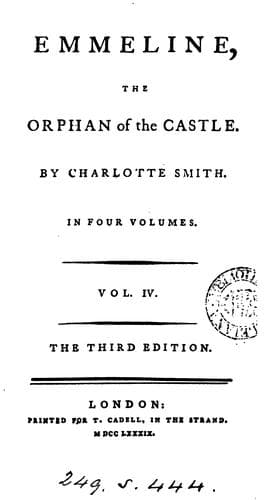
Emmeline, the Orphan of the CastleSmith, Charlotte
General
Emmeline, the Orphan of the Castle
Smith, Charlotte
Gothic fiction; Great Britain -- Social life and customs -- 18th century -- Fiction; Marriage -- Fiction; Single women -- Fiction
While the want of high birth and a title, which she had been taught to
consider as absolutely requisite to happiness, made her repress every
tendency to a serious engagement, she was extremely gratified by his
flattery; and when among other young women (from whom he affected not to
be able to stifle his unhappy passion,) she was frequently told how
much he was in love with her, she was accustomed to answer--'Ah! poor
fellow; so he is, and I heartily pity him.'
But while Lord and Lady Montreville thought Crofts's attendance on their
daughters quite without consequence, he and his father insinuated an
intended connection between him and one of them, with so much art, that
tho' it never reached the ears of the family it was universally believed
in the world.
A young nobleman who had passed the greater part of his life in the
army, where he had lately signalized himself by his bravery and conduct,
now returned to England on being promoted to a regiment; and having some
business to transact with Lord Montreville in his official capacity, he
was invited to the house, and greatly admired both the Miss Delameres,
whose parties he now joined at Bath.
Crofts soon afterwards obtaining a short respite from his political
engagement, went thither also; and tho' Miss Delamere really thought
Lord Westhaven quite unexceptionable, she had been so habituated to
behave particularly to Crofts, that she could not now alter it, or
perhaps was not conscious of the familiar footing on which she allowed
him to be with her.
Lord Westhaven, who had at first hesitated between the sprightly dignity
of the elder sister, and the soft and more bewitching graces of the
younger, no sooner saw the conduct of Miss Delamere towards Crofts, than
his doubts were at an end. Her faults of temper had been hitherto
concealed from him, and he believed her heart as good as her sister's;
indeed, according to the sentimental turn her discourse frequently took,
he might have supposed it more refined and sublime. But when he observed
her behaviour to Crofts, he thought that she must either be secretly
engaged to him, or be a decided coquet. Turning therefore all his
attention to Augusta, he soon found that her temper was as truly good as
her person was interesting, and that the too great timidity of her
manner was solely owing to her being continually checked by her mother's
partiality to her sister.
A very short study of her character convinced him she was exactly the
woman calculated to make him happy. He told her so; and found her by no
means averse to his making the same declaration to her father and
mother.
Public-domain text, read in full here on John Shaqi.
Reviews
Reviews
No reviews yet
Be the first to share your thoughts on this work.
Elsewhere in the archive
Join the Discussion
Join the discussion
Sign in to leave a comment or review.
Sign InorCreate an account