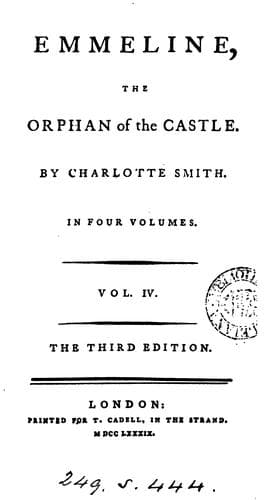
Emmeline, the Orphan of the CastleSmith, Charlotte
General
Emmeline, the Orphan of the Castle
Smith, Charlotte
Gothic fiction; Great Britain -- Social life and customs -- 18th century -- Fiction; Marriage -- Fiction; Single women -- Fiction
Fitz-Edward, however, having talked apart with Miss Mowbray a short
time, arose and took leave, having by his manner convinced Mrs. Ashwood
of what she reluctantly believed, that some later attachment had
obliterated the impression she had made at their first interview.
'I never saw such a figure in my life,' cried she, 'as Mr. Fitz-Edward.
Mercy on me!--he is grown _so_ thin, and _so_ sallow!'
'And _so_ stupid,'interrupted Miss Galton. 'He is in love I fancy.'
Emmeline blushed again; and Mrs. Ashwood casting a malicious look at
her, said--'Oh! yes--he doubtless is in love. To men of his gay turn you
know it makes no difference, whether a person be actually married or
_engaged_.'
Emmeline, uncertain of the meaning of this sarcasm, and unwilling to be
provoked to make a tart reply, which she felt herself ready to do, put
up her work and left the room.
While she went in search of Mrs. Stafford, to enquire after Lady
Adelina, and to relate the conversation that had passed between her and
Fitz-Edward, Mrs. Ashwood and Miss Galton were indulging their natural
malignity. Tho' well apprized of Emmeline's engagement to Delamere, yet
they hesitated not to impute her confusion, and Fitz-Edward's behaviour,
to a passion between them. They believed, that while her elopement with
Delamere had beyond retreat entangled her with him, and while his
fortune and future title tempted her to marry him, her heart was in
possession of Fitz-Edward; and that Delamere was the dupe of his
mistress and his friend.
This idea, which could not have occurred to a woman who was not herself
capable of all the perfidy it implied, grew immediately familiar with
the imagination of Mrs. Ashwood, and embittered the sense of her own
disappointment.
Miss Galton, who hated Emmeline more if possible than Mrs. Ashwood,
irritated her suspicions by remarks of her own. She observed 'that it
was very extraordinary Miss Mowbray should walk out so early in a
morning, and so studiously avoid taking any body with her--and that
unless she had appointments to which she desired no witness, it was very
singular she should chuse to ramble about by herself.'
From these observations, and her evident confusion on seeing him, they
concluded that she had daily assignations with Fitz-Edward. They agreed,
that it would be no more than common justice to inform Mr. Delamere of
their discovery; and this they determined to do as soon as they had
certain proofs to produce, with which they concluded a very little
trouble and attention would furnish them.
Public-domain text, read in full here on John Shaqi.
Reviews
Reviews
No reviews yet
Be the first to share your thoughts on this work.
Elsewhere in the archive
Join the Discussion
Join the discussion
Sign in to leave a comment or review.
Sign InorCreate an account