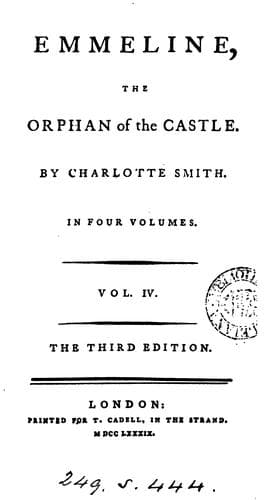
Emmeline, the Orphan of the CastleSmith, Charlotte
General
Emmeline, the Orphan of the Castle
Smith, Charlotte
Gothic fiction; Great Britain -- Social life and customs -- 18th century -- Fiction; Marriage -- Fiction; Single women -- Fiction
While the confederates, exulting in the certainty of Emmeline's ruin,
were manufacturing the letter which was to alarm the jealous and
irascible spirit of Delamere, Fitz-Edward, (from whom Mrs. Stafford,
before she would tell him any thing, had extorted a promise that he
would enquire no farther than what she chose to relate to him,) was
relieved from insupportable anguish by hearing that Lady Adelina was in
safe hands; but he lamented in bitterness of soul the despondency and
affliction to which Mrs. Stafford had told him she entirely resigned
herself. He knew not that Emmeline was with her, whatever he might
suspect; and Mrs. Stafford had protested to him, that if he made any
attempt to discover the residence of Lady Adelina, or persisted in
meeting her brother, she would immediately relinquish all concern in the
affair, and no longer interest herself in what his rashness would
inevitably render desperate.
He solemnly assured her he would take no measures without her
knowledge; and remained at Tylehurst, secluded from every body, and
waiting in fearful and anxious solicitude to hear of Lady Adelina by
Mrs. Stafford.
Delamere, (still at Nice with his mother,) who with different sources of
uneasiness thought the days and weeks insupportably long in which he
lived only in the hope of seeing Emmeline at the end of six months, was
roused from his involuntary resignation by the following letter, written
in a hand perfectly unknown to him.
'Sir,
'A friend to your worthy and noble family writes this; which is
meant to serve you, and to undeceive you in regard to Miss
Mowbray--who, without any gratitude for the high honour you intend
her, is certainly too partial to another person. She is now gone
from Woodfield to escape observation; and none but Mrs. Stafford is
let into the secret of where she is. You will judge what end it is
to answer; but certainly none that bodes you good. One would have
supposed that the Colonel's being very often her attendant at
Woodfield might have made her stay there agreeable enough; but
perhaps (for I do not aver it) the young lady has some particular
reasons for wishing to have private lodgings. No doubt the Colonel
is a man of gallantry; but his friendship to you is rather more
questionable. The writer of this having very little knowledge of the
parties, can have no other motive than the love of justice, and
being sorry to see deceit and falsehood practised on a young
gentleman who deserves better, and who has a respectful tho' unknown
friend in
Y. Z.'
_London, July 22, 17--._
Public-domain text, read in full here on John Shaqi.
Reviews
Reviews
No reviews yet
Be the first to share your thoughts on this work.
Elsewhere in the archive
Join the Discussion
Join the discussion
Sign in to leave a comment or review.
Sign InorCreate an account