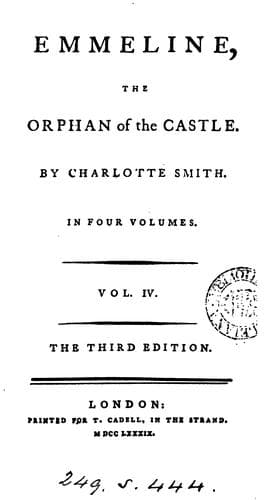
Emmeline, the Orphan of the CastleSmith, Charlotte
General
Emmeline, the Orphan of the Castle
Smith, Charlotte
Gothic fiction; Great Britain -- Social life and customs -- 18th century -- Fiction; Marriage -- Fiction; Single women -- Fiction
Fitz-Edward had received from Mrs. Stafford an account of all that had
passed at Bath, except the pains which had been taken to prevent any
meeting between him and Godolphin. But notwithstanding her cautious
silence on that head, Fitz-Edward, who knew Godolphin well, could hardly
be persuaded not to insist on his taking his chance of depriving him of
a life which he said he had deserved to lose, and could little brook
being supposed to hold on courtesy. Nothing but his consideration for
the unhappy Lady Adelina prevented his pursuing the sanguinary projects
that agitated his mind. To her peace he owed it to conquer them; and
while he was yet struggling against that sense of honour which impelled
him to give Godolphin imaginary reparation, by allowing him an
opportunity of putting an end to _his_ existence or losing his own, his
brother, Lord Clancarryl, wrote to desire his attendance in Ireland on
some family business of importance; a summons, which after some
hesitation, Mrs. Stafford and Miss Mowbray prevailed with him to obey.
Before he went, his eager and affecting entreaties prevailed on Mrs.
Stafford to let him see his son, whom he embraced with an ardour of
affection of which the fair friends believed so gay and fashionable a
man incapable.
The errors of Fitz-Edward, however, were not those of the heart. Among
the dissipation of fashion and the indulgences of libertinism, his heart
was still sensible, and his integrity retrievable. He felt, therefore,
with great keenness, the injury he had done Lady Adelina; and desirous
of making all the reparation he could to the infant, he again placed in
the hands of Emmeline, a will by which he made it his heir, and
recommended it to the protection of Godolphin, whom he besought to
consider as his nephew, the son of a man whom he had once loved, and who
had dearly paid for having forfeited all claim to his friendship. When
he was departed, nothing seemed likely to interrupt the tranquillity of
Emmeline but her encreasing apprehensions for Mrs. Stafford and her
children. The derangement of Stafford's affairs, and his wife's
unavailing efforts to ward off the ruin which he seemed obstinately bent
on incurring, were every day more visible: while his capricious and
unreasonable temper, and a strange opinion of his own sagacity, which
would never allow him to own himself in the wrong, made him seek to load
his wife with the blame of those misfortunes which he had voluntarily
sought, and now as obdurately refused to avoid while it was yet in his
power.
Mrs. Stafford, who saw too plainly that the destruction of their fortune
which she had so long dreaded was now with hasty strides advancing, yet
endeavoured to convince him of his infatuation; but he still improved
his house and garden, still schemed away all the money he could raise or
gain credit for, and still repaid with rudeness and insult her anxious
solicitude to save him.
Public-domain text, read in full here on John Shaqi.
Reviews
Reviews
No reviews yet
Be the first to share your thoughts on this work.
Elsewhere in the archive
Join the Discussion
Join the discussion
Sign in to leave a comment or review.
Sign InorCreate an account