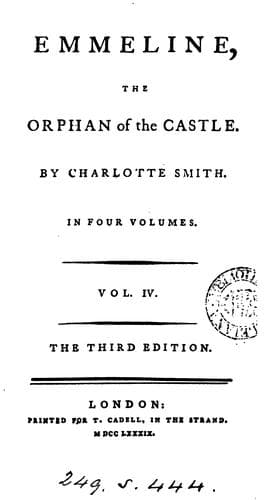
Emmeline, the Orphan of the CastleSmith, Charlotte
General
Emmeline, the Orphan of the Castle
Smith, Charlotte
Gothic fiction; Great Britain -- Social life and customs -- 18th century -- Fiction; Marriage -- Fiction; Single women -- Fiction
That Delamere should be in England did not greatly astonish tho' it
grieved her; but that he should have conceived such strange suspicions
of her and Fitz-Edward, equally surprised and distressed her; since,
had she an opportunity of undeceiving him, which he did not seem willing
to allow her, she could not relate the truth but by betraying the
confidence of her unfortunate friend, and embittering that life she had
incurred such hazards to preserve. As soon as she had apparently
recovered from the shock of this abrupt intrusion, she was desirous of
returning to Woodfield; anxious to know if Delamere had been there, or
by what means he had been enabled to find her at the cottage in the
forest. The women, who fancied the gentleman they had seen was a lunatic
who might lay in wait to hurt her on her way home, would not suffer her
to set out 'till they had called a woodcutter from the forest to
accompany her. Then, slowly and with difficulty, she returned home;
where she heard from Mrs. Stafford that Delamere had neither been there
or sent thither. This information encreased her wonder and her disquiet.
She related to Mrs. Stafford the distressing interview of the morning;
who, having seen frequent instances of those excesses of which Delamere
was capable, heard the relation with concern and apprehension.
CHAPTER VIII
Some days were passed by Emmeline in painful conjectures on what
measures Delamere would take, and in uncertainty what she ought to do
herself. Sometimes she thought of writing to Lord Montreville: but
against that Mrs. Stafford remonstrated; representing, that as she was
undoubtedly the injured person, in having been insulted by suspicions so
unworthy, she should leave it wholly to Delamere to discover and recant
his error; which, if he refused on cooler reflection to do, she would be
fortunate in escaping from an engagement with a man who had so little
command of his own temper, so little reliance on her principles, as to
be driven on a mere suspicion into rudeness and insult.
Greatly mortified at finding it possible for Delamere to think so
injuriously of her, and depressed by a thousand uneasy apprehensions,
she yielded implicitly to the counsel of her friend. But of her counsel
and consolation she was now on the point of being deprived: Stafford,
who had been some time in London, sent an express to fetch his wife
thither a few days after the interview between Emmeline and Delamere.
His affairs were now growing desperate: James Crofts demanded immediate
payment of a sum of money belonging to his wife, that was left her by
her father, and which she had 'till now suffered to remain in the hands
of her brother. Stafford had made no provision to pay it: his boundless
profusion had dissipated all the ready money he could command; and this
claim of his sister's, which James Crofts seemed determined to urge,
would he knew be the signal for every other creditor to beset him with
demands he had no means of discharging.
Public-domain text, read in full here on John Shaqi.
Reviews
Reviews
No reviews yet
Be the first to share your thoughts on this work.
Elsewhere in the archive
Join the Discussion
Join the discussion
Sign in to leave a comment or review.
Sign InorCreate an account