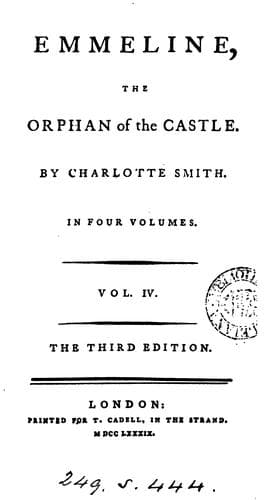
Emmeline, the Orphan of the CastleSmith, Charlotte
General
Emmeline, the Orphan of the Castle
Smith, Charlotte
Gothic fiction; Great Britain -- Social life and customs -- 18th century -- Fiction; Marriage -- Fiction; Single women -- Fiction
Sir Richard then related all that his son had told him; interlarding his
account with every circumstance that might induce his Lordship to
believe he was himself entirely ignorant of the intrigue. Lord
Montreville, however, knew too much of mankind in general, and of the
Crofts' in particular, to give implicit credit to this artful recital.
But Sir Richard was now become so necessary to him, and they had so many
secrets in common of great consequence to the political reputation of
both, that he could not determine to break with him. He considered too
that resentment could not unmarry his daughter; that the lineal honours
of his family could not be affected by her marriage; and that he owed
the Crofts' some favour for having counteracted the indiscretion of
Delamere. Determining therefore, after a short struggle, to sacrifice
his pride to his politics, he dismissed Sir Richard with infinitely less
appearance of resentment than he expected; and after long contention
with the furious and irascible pride of his wife, prevailed upon her to
let her daughter depart without her malediction. She would not see
Crofts, or pardon her daughter; protesting that she never could be
reconciled to a child of her's who bore such an appellation as that of
'_Mrs. Crofts_.' Soon afterwards, however, the Marquisate which Lord
Montreville had been so long promised was to be granted him. But his
wife could not bear, that by assuming a title which had belonged to the
Mowbray family, (a point he particularly wished to obtain) he should
drop or render secondary those honours which he derived from _her_
ancestors. Wearied by her persecution, and accustomed to yield to her
importunity, he at length gratified her, by relinquishing the name he
wished to bear, and taking the title of Marquis of Montreville, while
his son assumed that of Viscount Delamere. This circumstance seemed
more than any other to reconcile Lady Montreville to her eldest
daughter, whose surname she could evade under the more satisfactory
appellation of Lady Frances. She was now therefore admitted to her
mother's presence; Crofts received an haughty and reluctant pardon; and
some degree of tranquillity was restored to the noble house of
Mowbray-Delamere; while the Crofts', more elated and consequential than
before, behaved as if they had inherited and deserved the fortune and
splendor that surrounded them: and the table, the buildings, the
furniture of Sir Richard, vied in expence and magnificence with those of
the most affluent of the nobility.
Lord Delamere, to whom the acquisition of a title could offer nothing in
mitigation of the anguish inflicted by disappointed love, was now at
Dublin; where, immediately on his arrival, he had enquired for Colonel
Fitz-Edward at the house of his brother, Lord Clancarryl.
Public-domain text, read in full here on John Shaqi.
Reviews
Reviews
No reviews yet
Be the first to share your thoughts on this work.
Elsewhere in the archive
Join the Discussion
Join the discussion
Sign in to leave a comment or review.
Sign InorCreate an account