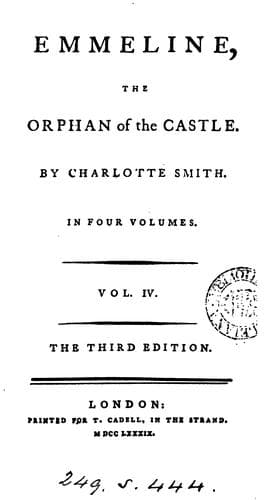
Emmeline, the Orphan of the CastleSmith, Charlotte
General
Emmeline, the Orphan of the Castle
Smith, Charlotte
Gothic fiction; Great Britain -- Social life and customs -- 18th century -- Fiction; Marriage -- Fiction; Single women -- Fiction
He was somewhat ashamed of the hasty conclusion he had made, and was
therefore more disposed to hear what Fitz-Edward had to say, who
presently convinced him that he was entirely ignorant of the flight of
Emmeline.
Delamere now insisted, that as a proof of his friendship he would
instantly set out with him in pursuit of her.
Fitz-Edward knew not what to do; but however seemed to consent; and
saying he would order his servant to get his horse, left him, and went
to Lord Montreville, to whom he represented the impracticability of
stopping Delamere.
His Lordship, almost certain that Emmeline was out of the possibility of
his overtaking her, as she had now been gone thirteen hours, thought it
better for Fitz-Edward, if he could not prevent his departure, to go
with him: but he desired him to make as many artificial delays as
possible.
Delamere, in the mean time, had been to Mrs. Stafford, and tried to
force from her the secret of Emmeline's route. But she was inexorable;
and proof against his phrenzy as well as his persuasion. She held him,
however, as long as she could, in discourse. But when he found she only
tried to make him lose time, he left her, in an agony of passion, and
mounting his horse, while his trembling servants were ordered to follow
him on pain of instant dismission, he rode out of the town without
seeing his father, leaving a message for Fitz-Edward that he had taken
the London road, and expected he would come after him instantly.
Lord Montreville intreated Fitz-Edward to lose not a moment; and bidding
an hasty adieu to his Lordship, he ordered his horses to the door of
Mrs. Stafford, where he took a formal leave of her and her husband,
entreating permission to renew his acquaintance hereafter. Then getting
on horseback, he made as much speed as possible after Delamere; whom
with difficulty he overtook some miles forward on the London road.
This way Delamere had taken on conjecture only; but after proceeding
some time, he had met a waggoner, whom he questioned. The man told him
of a post chaise he had met at four o'clock in the morning; and
encouraged by that to proceed, he soon heard from others enough to make
him believe he was right.
The horses, however, at the end of forty miles, were too much fatigued
to keep pace with Delamere's impatience. He was obliged to wait three
hours before post horses could be found for himself and Fitz-Edward. His
servants were obliged to remain yet longer; and the horses which were
at length procured, were so lame and inadequate to the journey, that it
was six hours before they reached the next stage; where the same
difficulty occurred; and Delamere, between the fatigue of his body and
anxiety of his mind, found himself compelled to take some rest.
Public-domain text, read in full here on John Shaqi.
Reviews
Reviews
No reviews yet
Be the first to share your thoughts on this work.
Elsewhere in the archive
Join the Discussion
Join the discussion
Sign in to leave a comment or review.
Sign InorCreate an account