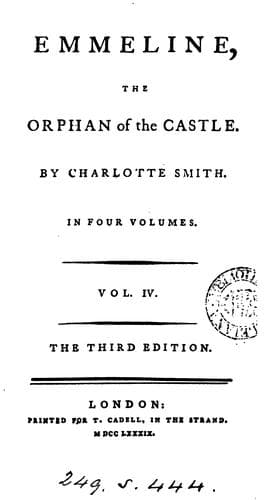
Emmeline, the Orphan of the CastleSmith, Charlotte
General
Emmeline, the Orphan of the Castle
Smith, Charlotte
Gothic fiction; Great Britain -- Social life and customs -- 18th century -- Fiction; Marriage -- Fiction; Single women -- Fiction
With one or two of these, Mrs. Ashwood and her father had at different
times encouraged overtures of marriage. But they knew and enjoyed the
pleasure their fortune and single state afforded them too well to give
those indulgences up for the advantage of increasing their incomes,
unless the object had possessed greater attractions than fell to the
share of Mrs. Ashwood; and her father could not be prevailed upon to
give her (at least while he lived) a sum of money large enough to tempt
their avarice. These overtures therefore had ended in nothing more than
an intercourse of civility.
But Emmeline no sooner appeared, than one of these gentlemen renewed his
visits with more than his original assiduity.
The extreme beauty of her person, and the _naivetè_ of her manners, gave
her, to him, the attractive charms of novelty; while the mystery there
seemed to be about her, piqued his curiosity.
It was known that she was related to a noble family; but Mrs. Ashwood
had been so earnestly entreated to conceal as much as possible her real
history, lest Delamere should hear of and discover her, that she only
told it to a few friends, and it had not yet reached the knowledge of
Mr. Rochely, who had become the attendant of Mrs. Ashwood's tea table
from the first introduction of Emmeline.
Mr. Rochely was nearer fifty than forty. His person, heavy and badly
proportioned, was not relieved by his countenance, which was dull and
ill-formed. His voice, monotonous and guttural, was fatiguing to the
ear; and the singularity of his manners, as well as the oddness of his
figure, often excited a degree of ridicule, which the respect his riches
demanded could not always stifle.
With a person so ill calculated to inspire affection, he was very
desirous of being a favourite with the ladies; and extremely sensible of
their attractions. In the inferior ranks of life, his money had procured
him many conquests, tho' he was by no means lavish of it; and much of
the early part of his time had been passed in low amours; which did not,
however, impede his progress to the great wealth he possessed. He had
always intended to marry: but as he required many qualifications in a
wife which are hardly ever united, he had hesitated till he had long
been looked upon as an old bachelor.
He was determined to chuse beauty, but expected also fortune. He desired
to marry a woman of family, yet feared the expensive turn of those
brought up in high life; and had a great veneration for wit and
accomplishments, but dreaded, lest in marrying a woman who possessed
them, he should be liable to be governed by superior abilities, or be
despised for the mediocrity of his own understanding.
With such ideas, his relations saw him perpetually pursuing some
matrimonial project; but so easily frightened from his pursuit, that
they relied on his succession with the most perfect confidence.
Public-domain text, read in full here on John Shaqi.
Reviews
Reviews
No reviews yet
Be the first to share your thoughts on this work.
Elsewhere in the archive
Join the Discussion
Join the discussion
Sign in to leave a comment or review.
Sign InorCreate an account