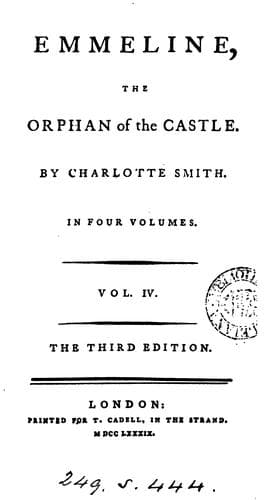
Emmeline, the Orphan of the CastleSmith, Charlotte
General
Emmeline, the Orphan of the Castle
Smith, Charlotte
Gothic fiction; Great Britain -- Social life and customs -- 18th century -- Fiction; Marriage -- Fiction; Single women -- Fiction
Delamere, all warmth and openness himself, detested the narrow-minded
and selfish father; and had shewn so much coolness towards the sons,
that Sir Richard foresaw he would be a great impediment to his designs,
and had therefore the strongest motive for trying to persuade Lord
Montreville, that to send him on another tour to the Continent, would be
the best means of curing him of what this deep politician termed 'a
ridiculous and boyish whim, which his Lordship ought at all events to
put an end to before it grew of a more dangerous consequence.'
Mr. Crofts, as he was no sportsman, passed his mornings in riding out
with Miss Delamere and Miss Otley, or attending on the elder ladies in
their airings: while Delamere, who wished equally to shun Miss Otley,
whom he determined never to marry, and Crofts, whom he despised and
hated, lived almost alone, notwithstanding the entreaties of his father
and the anger of his mother.
Her Ladyship, who had never any command over her passions, harrassed
him, whenever they met, with sarcasms and reflections. Lady Mary,
scorning _to_ talk to a young man who was blind to the merits of her
daughter, talked _at_ him whenever she found an opportunity; and
exclaimed against the disobedience, dissipation, and ill-breeding of
modern young men: while Miss Otley affected a pretty disdain; and
flirted violently with Mr. Crofts, as if to shew him that she was
totally indifferent to his neglect.
The temper of Delamere was eager and irritable; and he bore the
unpleasantness of this society, whenever he was forced to mix in it,
with a sort of impatient contempt. But as he hourly found it more
irksome, and the idea of Emmeline press every day more intensely on his
heart, he determined, at the end of the third week, to go to London.
Not chusing to have any altercation with either Lord or Lady
Montreville, he one evening ordered his man to have his horses ready at
five o'clock the next day, saying he was to meet the foxhounds at some
distance from home; and having written a letter to his Lordship, in
which he told him he was going to London for a fortnight, (which letter
he left on the table in his dressing-room) he mounted his horse, and was
soon in town; but instead of going to the house of his father in
Berkley-square, he took lodgings in Pall-Mall.
Every night he frequented those public places which were yet open, in
hopes of finding Emmeline; and his servant was constantly employed for
the same purpose; but as he had no trace of her, all his enquiries were
fruitless.
On the night that Emmeline was at the play, he had been at Covent-garden
Theatre, and meant to have looked into the other house; but was detained
by meeting a young foreigner from whom he had received civilities at
Turin, 'till the house was empty. So narrowly did he miss finding her he
so anxiously sought.
Public-domain text, read in full here on John Shaqi.
Reviews
Reviews
No reviews yet
Be the first to share your thoughts on this work.
Elsewhere in the archive
Join the Discussion
Join the discussion
Sign in to leave a comment or review.
Sign InorCreate an account