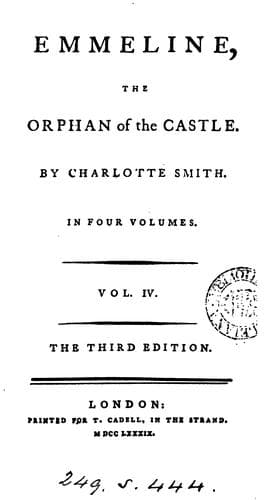
Emmeline, the Orphan of the CastleSmith, Charlotte
General
Emmeline, the Orphan of the Castle
Smith, Charlotte
Gothic fiction; Great Britain -- Social life and customs -- 18th century -- Fiction; Marriage -- Fiction; Single women -- Fiction
As soon as the servant informed her they were ready, she went down: and
Delamere followed her, having first wished Mrs. Ashwood a good night;
who was too much displeased with the little attention he had shewn her,
to ask him to supper, tho' she was very desirous of having a man of his
fashion in the list of her acquaintance.
Delamere and Emmeline were no sooner alone, than he began to renew, with
every argument he thought likely to move her, his entreaties for a
private marriage. He swore that he neither could or would live without
her, and that her refusal would drive him to some act of desperation.
Emmeline feared her resolution would give way; for the comparison
between the people she had lately been among, and Delamere, was
infinitely favourable to him. Such unabated love, in a man who might
chuse among the fairest and most fortunate of women, was very seducing;
and the advantages of being his wife, instead of continuing in the
precarious situation she was now in, would have determined at once a
mind more attentive to pecuniary or selfish motives.
But Emmeline, unshaken by such considerations, was liable to err only
from the softness of her heart.
Delamere unhappy--Delamere wearing out in hopeless solicitude the bloom
of life, was the object she found it most difficult to contend with: and
feeble would have been her defence, had she not considered herself as
engaged in honour to Lord Montreville to refuse his son, and still more
engaged to respect the peace of the family of her dear Augusta.
Strengthened by these reflections, she refused, tho' in the gentlest
manner, to listen to such proposals; reproached him, tho' with more
tenderness in her voice and manner than she had yet shewn, for having
left Audley Hall without the concurrence of Lord Montreville; and
entreated him to return, and try to forget her.
'Let me perish if I do!' eagerly answered Delamere. 'No, Emmeline; if
you determine to push me to extremities, to you only will be the misery
imputable, when my mistaken parents, in vain repentance, hang over the
tomb of their only son, and see the last of his family in an early
grave. It is in your power only to save me--You refuse--farewel, then--I
wish no future regret may embitter your life, and that you may find
consolation in being the wife of some one of those persons who are, I
see, offering you all that riches can bestow. Farewel, lovely, inhuman
girl! be happy if you can--after having sacrificed to a mistaken point
of honour, the repose and the life of him who lived only to adore you.'
So saying, he suddenly opened the door, and was leaving the room. But
Emmeline, who shuddered at the picture he had drawn of his despair, and
saw such traces of its reality on his countenance, caught his arm.
'Stay! Mr. Delamere,' cried she, 'stay yet a moment!'
'For what purpose?' answered he, 'since you refuse to hear me?'
Public-domain text, read in full here on John Shaqi.
Reviews
Reviews
No reviews yet
Be the first to share your thoughts on this work.
Elsewhere in the archive
Join the Discussion
Join the discussion
Sign in to leave a comment or review.
Sign InorCreate an account