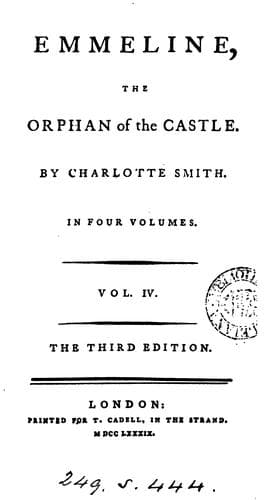
Emmeline, the Orphan of the CastleSmith, Charlotte
General
Emmeline, the Orphan of the Castle
Smith, Charlotte
Gothic fiction; Great Britain -- Social life and customs -- 18th century -- Fiction; Marriage -- Fiction; Single women -- Fiction
Sir Richard, himself wholly insensible to the feelings of a father,
discouraged in Lord Montreville every tendency to forgive or indulge
this indiscreet passion. And equally incapable of the generous
sentiments of a gentleman towards a woman, young, helpless, dependant,
and unfortunate, he tried to harden the heart of Lord Montreville
against his orphan niece, and advised him peremptorily to insist on her
marrying Rochely immediately, or, as the alternative, to declare to her
that from the moment of her refusal she must expect from him neither
support or countenance.
This threat on one hand, and the affluence offered her by Rochely on the
other, must, he thought, oblige her to embrace his proposals. The
greatest difficulty seemed to be, to prevent Delamere's impetuosity from
snatching her at once out of the power of his father, by an elopement;
to which, if she preferred him to Rochely, it was very probable she
might be driven by harsh measures to consent; and that Delamere must
have in her heart a decided preference, there could be little doubt.
Lord Montreville was apprehensive that Delamere, who had, he found, for
many days lived entirely at Mrs. Ashwood's, would be there before him in
the morning, and preclude all possibility of a private conversation with
Emmeline.
Fitz-Edward, who could, and from the duplicity of his character would
perhaps have made a diversion in his favour, was not in town; and to
both the Mr. Crofts Delamere had an antipathy, which he took very little
pains to conceal; they therefore could not be employed to engage him.
In this difficulty, Sir Richard offered to go himself to Miss Mowbray,
that Lord Montreville might be at liberty to detain his son; pretences
for which could not be wanting.
His Lordship closed with this offer with pleasure; and felt himself
relieved from a painful task. His heart, though greatly changed by a
long course of good fortune, and by the habit of living among the great,
was yet not quite lost to the feelings of nature.
His brother, than whom he was only a year younger, and whom he had loved
thro' childhood and youth with singular attachment, was not wholly
forgotten; and the softened likeness, in the countenance of Emmeline, to
one whom he had so long been used to look up to with tenderness,
frequently said as much for her to his affection, as her unprotected and
helpless state did to his honour and his compassion. Nor, whatever pains
he took to stifle his pity for his son, could he entirely reconcile to
his own heart the part he was acting.
But of these feelings, meritorious as they were, he was ashamed, and
dared not avow them even to himself; while he was intimidated by the
supercilious spirit and unconquerable pride of Lady Montreville, and
tempted by the visions of encreasing splendour and accumulated riches
which Sir Richard perpetually presented to his imagination, and which
there was indeed but little doubt of realizing.
Public-domain text, read in full here on John Shaqi.
Reviews
Reviews
No reviews yet
Be the first to share your thoughts on this work.
Elsewhere in the archive
Join the Discussion
Join the discussion
Sign in to leave a comment or review.
Sign InorCreate an account