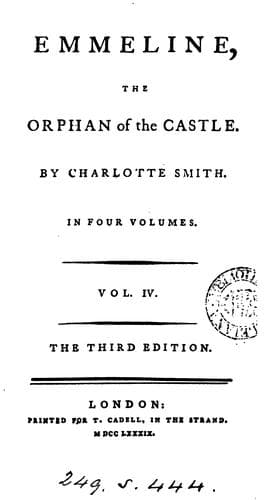
Emmeline, the Orphan of the CastleSmith, Charlotte
General
Emmeline, the Orphan of the Castle
Smith, Charlotte
Gothic fiction; Great Britain -- Social life and customs -- 18th century -- Fiction; Marriage -- Fiction; Single women -- Fiction
'And now, my dear Miss Mowbray, as the visitors who have been with
me ever since my return from Swansea, are happily departed and no
others expected, and as Mr. Stafford will be engaged in town almost
all the winter, in consequence of his father's death, will you not
come to me? _You_ only can alleviate and share a thousand anxieties
that prey on my spirits; _you_ only can sweeten the hour of my
confinement, which will happen in January; and before _you_ only I
can sigh at liberty and be forgiven.
'Ah! Emmeline--the death of Mr. Stafford's father, far from
producing satisfaction as increasing our fortune, brings to me only
regret and sorrow. He loved me with great affection; and I owe him a
thousand obligations. The family will have reason to regret his
loss; tho' the infirmities of the latter part of his life were not
much alleviated by their attendance or attention.
'Come to me, Emmeline, if possible; come, if you can, with Mr.
Stafford; or if he is detained long in town, come without him. I
will send my post-chaise to meet you at Basingstoke. Lord
Montreville cannot object to it; and Delamere, whom you have never
mentioned, has, I conclude, given way to the peremptory commands of
his father, and has determined to forget my Emmeline.
'Is it then probable any one can forget her? I know not of what
the volatile and thoughtless Delamere may be capable; but I know
that of all things it would be the most impossible to her truly
attached and affectionate,
C. STAFFORD.'
_Woodfield, Nov. 30._
This letter gave great relief to the mind of the dejected Emmeline. That
her first and dearest friend, opened at this painful crisis her
consolatory bosom to receive and pity her; and that she should have the
power to share her fatigue, and lessen the weight of her anxiety during
the slow recovery of her child; seemed to be considerations which
softened all the anguish she had endured during the day.
She was however too much disordered to go down to tea; and told Mrs.
Ashwood, who civilly came up to enquire after her, that she had a
violent pain in her head and would go to bed.
Mrs. Ashwood, full of her increased fortune, and busied in studying to
make her deep mourning as becoming as possible, let her do as she would,
and thought no more about her.
She had therefore time to meditate at leisure on her wayward fate: and
some surprise that Delamere had not appeared the whole day, mingled
itself with her reflections.
Poor Delamere was not to blame. Lord Montreville had sent him very early
in the morning to desire to see him for five minutes on business of
consequence.
Public-domain text, read in full here on John Shaqi.
Reviews
Reviews
No reviews yet
Be the first to share your thoughts on this work.
Elsewhere in the archive
Join the Discussion
Join the discussion
Sign in to leave a comment or review.
Sign InorCreate an account