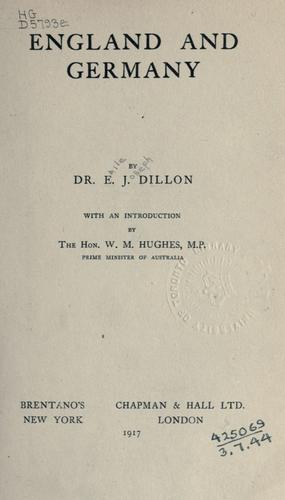
Germany -- Foreign relations; World War, 1914-1918; World War, 1914-1918 -- Economic aspects
The depth and fervour of this self-denying spirit among them as
contrasted with the "healthy individual egotism" of the Allies
constitutes one of the most disquieting phenomena of the struggle.
Austria has been scoffed at for her abject submissiveness to Germany.
But there is another way of looking at her attitude. She has
courageously effaced her individuality more completely even than
Turkey for the sake of the common cause. And she has lost nothing by
the painful effort. Her various peoples who were expected to be
tearing each other to pieces have given us a splendid example of
discipline and self-abnegation. In the Skoda works at Pilsen, where
machine guns are made, fifteen thousand workmen are cheerfully toiling
and moiling every day of the week, Sundays and holidays not excepted.
Since the war began Germany has accomplished as great things at home
as on foreign battlefields. She built and launched a Dreadnought of
25,600 tons, a line-of-battle ship of 26,200 tons. And while the
latter vessel was on the stocks, the reports published in the British
press of the splendid results obtained by the 15-inch guns of the
_Queen Elizabeth_ moved the German Admiralty to substitute these for
the 12-inch guns already adopted. Two swift cruisers, 12 small
submarines and 24 larger ones of 1200 tons displacement, with a speed
of 16 knots under water, 20 on the surface and a radius of action of
3000 miles--were among the results of a single year's activity.
CHAPTER XVII
GERMANY'S RESOURCEFULNESS
And our enemies' resourcefulness and power of adaptation is of a piece
with their capacity for work. When war was declared and foreign trade
arrested, numerous German factories underwent a quick transformation.
Silk-works began to turn out bandages and lint; velvet works produced
materials for tents; umbrella makers took to manufacturing rain-proof
cloth; the output of sewing-machine factories was changed to shrapnel;
piano manufacturers became makers of cartridges. Paper producers
supplied the War Office with paper-made blankets. For copper, when the
supply began to grow short, nickelled iron was quickly substituted.
Sugar was employed to obtain the spirit which had to take the place of
benzine. And the upshot of these transformations is that the orders
received for military needs exceed those which would in normal
conditions of exportation have been placed by foreign customers with
German industry. The goods traffic on German railways, which had
fallen to 41 per cent. during the first month of the war, has since
gone up to 96 per cent. Those achievements are not merely noteworthy
in themselves, they are ominously symptomatic.
Public-domain text, read in full here on John Shaqi.
Reviews
Reviews
No reviews yet
Be the first to share your thoughts on this work.
Elsewhere in the archive
Join the Discussion
Join the discussion
Sign in to leave a comment or review.
Sign InorCreate an account