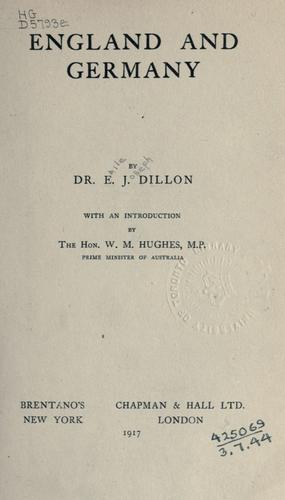
Germany -- Foreign relations; World War, 1914-1918; World War, 1914-1918 -- Economic aspects
Now, there is every reason to assume that these master facts are not
yet recognized by our rulers, who seem perfectly contented that the
nation should go on living as before from hand to mouth, with no
far-reaching views for the future. This insular narrow-mindedness is
natural. For the Ministers in power are the same who obstinately
refused to credit the evidence of their senses, which went to prove
that Germany was bending all her energies to the successful
prosecution of a formidable campaign against us and our presumptive
allies for a whole generation. The frank recognition of this state of
masked hostility would have imposed on the Government the correlate
duty of taking up the challenge, readjusting our public life to the
altered conditions, urging the nation to make heavy sacrifices and
dissatisfying radical constituencies, whose one ideal is to devote
themselves exclusively to parochial policy and domestic legislation.
And the chiefs of the party in power lacked the mental and moral
strength to throw off their deep-rooted apprehension of the
consequences to party prospects, of increased taxation and other
burdens of citizenship. They never grasped the situation as a whole,
but restricted their survey to each fragmentary question as it was
thrust into the foreground of actualities and eliminated every other.
CHAPTER XVIII
THE PERILS OF PARTY POLITICS
No bold, broad, stable policy, therefore, was ever conceived by those
party politicians. The vast organization which was destined to destroy
the old order of things in Europe, and whose manifestations were an
open book to all observers who brought acuteness and patience to the
study, was not merely ignored by them--its very existence was denied,
and those who refused to join the ranks of the deniers were
brand-marked as mischief-makers. The nation's responsible trustees, by
way of justifying this singular attitude, accepted implicitly our
enemy's account of his unfriendly acts and enterprises. Thus it was
the chief of His Majesty's Government who, from his place in the House
of Commons, emphatically asserted that it behoved the British nation
to welcome the Baghdad railway enterprise as a precious cultural
undertaking devoid of political objects and, therefore, well worthy of
our support. In vain the writer of these lines laid bare the real
designs of the German Government, and adduced cogent proofs that the
seemingly cultural scheme was but an integral part of a vast campaign,
of which one object was the ousting of Britons from the Near and
Middle East and the substitution of German overlordship there. They
shut their eyes and stopped their ears, and bade us rejoice that
Britain is not as other countries and can afford to welcome and even
further Germany's "cultural" projects.
Public-domain text, read in full here on John Shaqi.
Reviews
Reviews
No reviews yet
Be the first to share your thoughts on this work.
Elsewhere in the archive
Join the Discussion
Join the discussion
Sign in to leave a comment or review.
Sign InorCreate an account