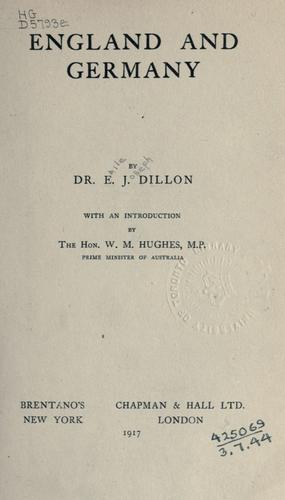
Germany -- Foreign relations; World War, 1914-1918; World War, 1914-1918 -- Economic aspects
It was the same men who conceived or sanctioned the plan of an
expedition to Mesopotamia. Whether this was a wise or a foolish
project, when once decided upon it should have been carried out with
might and main. All the means requisite to success should have been
taken; all the resources possessed by the Empire should have been
drawn upon and nothing needlessly left to chance. Above all things
else, the views of the man charged with the execution of the plan
should have been elicited and carefully weighed. As a matter of fact,
General Townshend's judgment was decidedly adverse to the expedition
under the conditions in which it was planned. For the forces assigned
to him, amounting to far less than a division, were absurdly
inadequate, and their inadequacy was easily demonstrable. He ought to
have had at least two divisions more. But once again the game of
divided control and diluted responsibility was played, with
consequences which would in any other country suffice to wreck the
Government chargeable with the blunder.
Yet it is to the men who committed that and all the other blunders
that the nation still looks confidently for salvation!
If the British people finally obtain it under those leaders they may
fairly claim to have abrogated the law of cause and effect.
These same men are still the mentors and the spokesmen of a free
nation which can choose its leaders. It is they to whom the people has
entrusted the conduct of the most critical phase of the whole campaign
in which the recurrence of similar errors may foredoom the Empire to
disruption. And it is, humanly speaking, inconceivable that
miscalculations of that kind should be eliminated, in view of the
crucial fact that the Ministers at present in power, if we may judge
by their utterances and their acts, entertain a fundamentally false
conception of the relations between the Teutons and the allied
nations. Among the elements of that conception there would seem to be
no room for the historic past. The present stands by itself with a
history that goes no further back than the month of July 1914, and
will convulsively come to an end with the truce that ushers in the
future treaty of peace. For that diplomatic instrument will put an end
to the struggle and inaugurate an era of international tranquillity.
Such is the theory on which their entire policy is based.
We must fight on now to a _finish_, but the upshot is sure to be a
finish. Their anticipations of an unclouded dawn, when the present
night has worn itself into the streaky greyness of morning, are
certain to come to pass. The ordeal which we are undergoing is
tremendous, but at any rate the nation and its allies will emerge from
it rejuvenated under the spell of the present magicians, as the old
ram emerged lamb-like and frisky from Medea's cauldron. That, in
brief, would seem to be the picture in the mind's eye of the British
Government, and to that conception all their plans are being
accommodated.
Public-domain text, read in full here on John Shaqi.
Reviews
Reviews
No reviews yet
Be the first to share your thoughts on this work.
Elsewhere in the archive
Join the Discussion
Join the discussion
Sign in to leave a comment or review.
Sign InorCreate an account