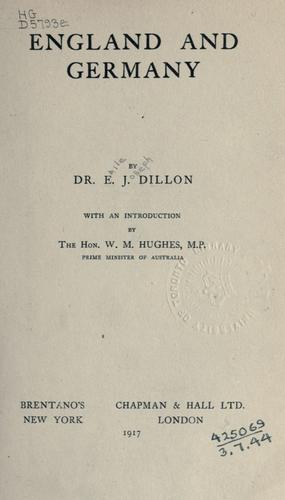
Germany -- Foreign relations; World War, 1914-1918; World War, 1914-1918 -- Economic aspects
In the Tsar's dominions German agents organized a series of strikes in
the various works belonging to their countrymen, paid the strikers and
fostered a subversive political movement which bade fair to culminate
in a real revolution. In Belgium the Flemings, who had for years been
protesting against the refusal of their Government to give them a
Flemish University in Ghent, were incited against the Walloons, whose
dialect is of French origin and whose sympathizers were the entire
French people. And one of the joint acts of the German administration
in Brussels has been to appoint a commission to submit a scheme for
the creation of a Flemish high school in Ghent and accentuate the
differences between the two elements of the population.[108]
[108] A spirited protest against this poisonous endeavour was
published by a number of Belgians, including Camille
Huysmans, who refused to accept any favours from the Germans.
Meanwhile, in Germany the work of organization went steadily forward.
While British Ministers were on the look-out for reasons or pretexts
for diminishing expenditure on shipbuilding, Germany, under von
Tirpitz, was stealing a march on us and increasing hers. And over and
above this, she was arranging a surprise in the shape of submarines
and aircraft which, had the war been deferred for another couple of
years, might have not only removed the odds in our favour but given
her a decided superiority over us. And, by way of intensifying the
value of her fleet, she set to work to deepen the Kiel Canal and thus
to confer a sort of ubiquity on her battleships, which can now
concentrate in the North Sea or the Baltic without let or hindrance
from the enemy. When the epoch of the Dreadnoughts was opened German
armoured ships had a displacement of no more than 13,000 tons. The
larger type of battleship, which was afterwards constructed, could not
pass through the Canal, which had to be deepened. The necessary work
was so thoughtfully and opportunely taken in hand that it was
terminated in July 1914, just when the harvest for that year was also
ingathered. Asphyxiating gas had been manufactured in the year 1911,
as the Russians have discovered on certain of the machines. Thus when
the fatal hour struck, everything was ready.
Public-domain text, read in full here on John Shaqi.
Reviews
Reviews
No reviews yet
Be the first to share your thoughts on this work.
Elsewhere in the archive
Join the Discussion
Join the discussion
Sign in to leave a comment or review.
Sign InorCreate an account