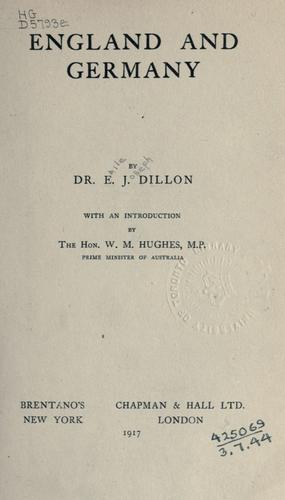
Germany -- Foreign relations; World War, 1914-1918; World War, 1914-1918 -- Economic aspects
Now, these achievements and the marvellous adaptability, energy and
resourcefulness which they connote, are no mean elements in Germany's
equipment for the coming economic struggle. They proclaim that the
mind of the Teuton man of business is too firmly riveted on the goal
to be fascinated by any special route leading towards it, and that it
is sufficiently free and disengaged to turn with eager interest to any
problem, however novel, with which it may be suddenly confronted. Use
and want are not its masters, sluggish contentment cannot numb its
activity. The customers' requirements, nay, their whims and fancies,
are ever sure to receive close attention and prompt satisfaction. The
contrast between this unflagging alertness and the drowsy apathy of
the British manufacturer and tradesman is an old story, which has
evoked comments sharp enough, it would seem, to arouse the commercial
community to a lively sense of its danger and duty. And yet there are,
unhappily, cogent grounds for believing that the malady of
listlessness is as malignant to-day as before the war.
Now, these organizing and inventive talents of the Teuton, as
compared with the subordinate aims, fitful energies and honest but
mischievous conservatism of our own leaders and people, bear witness
to the same twofold talent of the German for looking far ahead and
contriving expedients on the spur of the moment. Great Britain's
participation in the struggle cut off Germany from the sea and gave
the two Central Empires the aspect of a beleaguered city. Hopes were
entertained by the Allies that famine might reinforce the work of
their armies and navies in compelling the enemy to sue for peace.
About 9 per cent. of the corn used in Germany usually came from
abroad, and now the interruption of the communications rendered this
source of supply precarious. The soldiers, too, had to be fed on a
scale of greater abundance than usual, and the prisoners of war,
however poorly nourished, would consume a certain amount of corn. The
first measure promulgated to meet the new conditions was a prohibition
of exportation. Potato flour was employed in bread-baking. War bread
was standardized for the whole Empire. The principal cities purchased
vast quantities of cereals, and Prussia founded a War Corn Association
for the acquisition of cereals to be stored until the ensuing spring.
Expropriation was legalized. In these ways L40,000,000 worth of
cereals were got together for consumption. The War Corn Association
operated with a capital of L2,500,000, to which the States subscribed
over one million, and the big cities one million, and the great
industrial firms L450,000.[114] This corn was paid for at the highest
market rates, the owners being compelled by law to declare how much
they possessed. With each of these proprietors--in the first phase
with 5,000,000 landowners--separate arrangements were concluded. The
Association employed for the purpose nearly three thousand
Public-domain text, read in full here on John Shaqi.
Reviews
Reviews
No reviews yet
Be the first to share your thoughts on this work.
Elsewhere in the archive
Join the Discussion
Join the discussion
Sign in to leave a comment or review.
Sign InorCreate an account