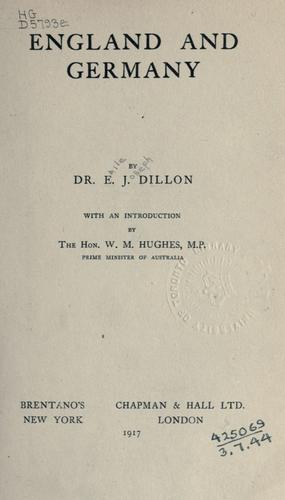
Germany -- Foreign relations; World War, 1914-1918; World War, 1914-1918 -- Economic aspects
The most terrific war known to history was raging in three Continents,
and one group of belligerents, unaware or heedless of the magnitude of
the issues, kept wasting its enormous resources and throwing away its
advantages. At the little station of Cognac waggons laden with all
kinds of war materials, barbed wire, galvanized wire, etc., were
detained from September 1914 until November 1915, 400 days in all,
doing nothing. Forty-two waggons ready to move were found on two
grass-covered rails. Fourteen waggons were there since September 1914.
Eight since December of the same year, twenty since June. Altogether
at the modest little station of Cognac the total recorded by Senator
Humbert's _Journal_ was 228,500 tons-days. "All this during the most
tremendous war the world has ever witnessed, in which hundreds of
thousands of men have been slain, where we have continually been short
of war material, while industry and commerce are agonizing for lack of
means of transport. It may well seem a dream."[135]
[135] _Le Journal_, November 26, 1915.
Seven hundred French railway stations were devoid of rolling stock. On
the other hand, from the beginning of the war down to November 1915,
729 waggons were lying immobilized at the station of Blanc-Mesnil.
Seven hundred and twenty-nine![136] Merchants, manufacturers,
importers, all were being literally beggared for lack of transports
while hundreds of waggons lay rotting at obscure little stations for
over a year. "The whole region of the West is encumbered," we read,
"with 30,000,000 hectolitres of apples, valued at 300,000,000 francs,
which cannot be conveyed anywhither, and which people are beginning to
bury in the earth as manure. Sugar is scarce and is rising in price,
whereas ever since last August[137] a single firm has unloaded 10,000
tons of sugar at Havre which it cannot have transported to Paris.
Innumerable army purveyors are unable to send the machines for the
shells...." An official order to the army prescribed a substitute for
barbed wire, which was not to be had at any price, yet at a single
station at least 135 tons of barbed wire were lying for a twelvemonth
unused, untouched.[138] On November 27, 1915, the military hospital
N16 at Poitiers needed coal. A request was made by telephone. The
reply received was: "We have coal at La Rochelle, but there are no
waggons to carry it." Yet there were forty-two waggons immobilized at
Cognac, 729 at Blanc-Mesnil and 121 standing laden with barbed wire
and other materials for over a year!
[136] _Le Journal_, December 2, 1915. They were photographed
and the photograph reproduced in that paper.
[137] That was published in December 1915.
[138] _Le Journal_, December 2, 1915.
Organization and intelligence!
Public-domain text, read in full here on John Shaqi.
Reviews
Reviews
No reviews yet
Be the first to share your thoughts on this work.
Elsewhere in the archive
Join the Discussion
Join the discussion
Sign in to leave a comment or review.
Sign InorCreate an account