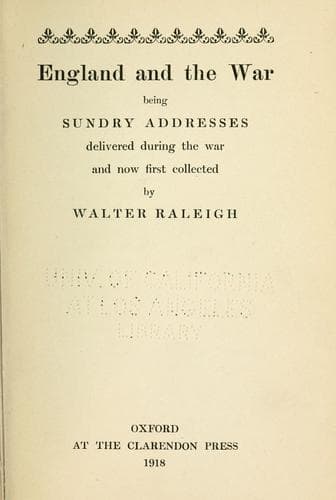
All this is reflected in Shakespeare. He knew the country, and he knew
the town; and he has not left it in doubt which was the cherished home
of his imagination. He preferred the fields to the streets, but the
Arcadia of his choice is not agricultural or even pastoral; it is rather
a desert island, or the uninhabited stretches of wild and woodland
country. Indeed, he has both described it and named it. 'Where will the
old Duke live?' says Oliver in _As You Like It_. 'They say he is already
in the forest of Arden,' says Charles the wrestler, 'and a many merry
men with him; and there they live like the old Robin Hood of England.
They say many young gentlemen flock to him every day, and fleet the time
carelessly, as they did in the golden world.' That is Shakespeare's
Arcadia; and who that has read _As You Like It_ will deny that it
breathes the air of Paradise?
It is quite plain that the freedom that Shakespeare valued was in fact
freedom, not any of those ingenious mechanisms to which that name has
been applied by political theorists. He thought long and profoundly on
the problems of society; and anarchy has no place among his political
ideals. It is by all means to be avoided--at a cost. But what harm would
anarchy do if it meant no more than freedom for all the impulses of the
enlightened imagination and the tender heart? The ideals of his heart
were not political; and when he indulges himself, as he did in his
latest plays, you must look for him in the wilds; whether on the road
near the shepherd's cottage, or in the cave among the mountains of
Wales, or on the seashore in the Bermudas. The laws that are imposed
upon the intricate relations of men in society were a weariness to him;
and in this he is thoroughly English. The Englishman has always been an
objector, and he has a right to object, though it may very well be held
that he is too fond of larding his objection with the plea of
conscience. But even this has a meaning in our annals; as a mere
question of right we are very slow to prefer the claim of the organized
opinions of society to the claim of the individual conscience. We know
that there is no good in a man who is doing what he does not will to do.
We are not like our poets or our men of action to be void of
inspiration. A gift is nothing if there is no benevolence in the giver:
For to the noble mind
Rich gifts wax poor when givers prove unkind.
We ask for the impulse as well as the deed. Even when he is speaking of
social obligations Shakespeare makes his strongest appeal not to force
or command, but to the natural piety of the heart:
If ever you have looked on better days,
If ever been where bells have knolled to church,
If ever sat at any good man's feast,
If ever from your eyelids wiped a tear,
And know what 'tis to pity and be pitied,
Let gentleness my strong enforcement be:
In the which hope I blush, and hide my sword.
Public-domain text, read in full here on John Shaqi.
Reviews
Reviews
No reviews yet
Be the first to share your thoughts on this work.
Elsewhere in the archive
Join the Discussion
Join the discussion
Sign in to leave a comment or review.
Sign InorCreate an account