That is not a little discovery, for when his mind came to grips with
human life Shakespeare did not deal in rhetoric; so that the good he
finds is real good--''tis in grain; 'twill endure wind and weather'.
Nothing is easier than to make a party of humanity, and to exalt mankind
by ignorantly vilifying the rest of the animal creation, which is full
of strange virtues and abilities. Shakespeare refused that way; he saw
man weak and wretched, not able to maintain himself except as a
pensioner on the bounty of the world, curiously ignorant of his nature
and his destiny, yet endowed with certain gifts in which he can find
sustenance and rest, brave by instinct, so that courage is not so much
his virtue as cowardice is his lamentable and exceptional fault, ready
to forget his pains or to turn them into pleasures by the alchemy of his
mind, quick to believe, and slow to suspect or distrust, generous and
tender to others, in so far as his thought and imagination, which are
the weakest things about him, enable him to bridge the spaces that
separate man from man, willing to make of life a great thing while he
has it, and a little thing when he comes to lose it. These are some of
his gifts; and Shakespeare would not have denied the saying of a thinker
with whom he has no very strong or natural affinity, that 'the greatest
of these is charity'.
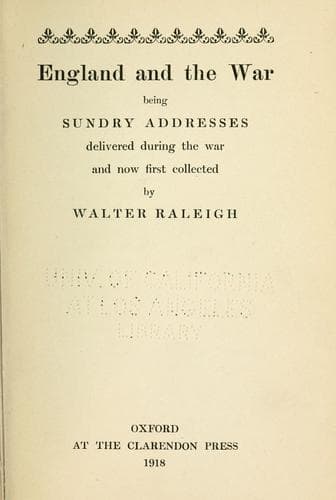
End of the Project Gutenberg EBook of England and the War, by Walter Raleigh
Public-domain text, read in full here on John Shaqi.
Reviews
Reviews
No reviews yet
Be the first to share your thoughts on this work.
Elsewhere in the archive
Join the Discussion
Join the discussion
Sign in to leave a comment or review.
Sign InorCreate an account