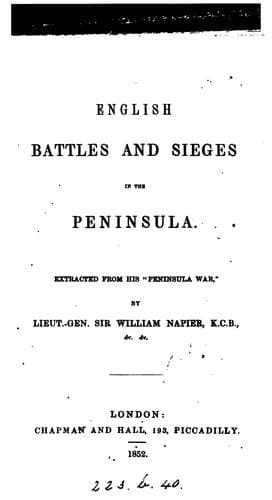
English Battles and Sieges in the Peninsula.: Extracted from his 'Peninsula War'.Napier, William Francis Patrick
History
English Battles and Sieges in the Peninsula.: Extracted from his 'Peninsula War'.
Napier, William Francis Patrick
Peninsular War, 1807-1814
After the storming of Badajos the English general desired to fight
Soult in Andalusia, and his cavalry under Sir Stapleton Cotton very
soon overtook the French horse and defeated them near Usagre with a
loss to the victors of fifty or sixty men, to the vanquished of two or
three hundred, one half being prisoners. Had that action been rapidly
followed up by a powerful army a great victory would probably have
crowned this extraordinary winter campaign, but obstacles, untimely and
unexpected, arose. Carlos España’s oppressions had created a dangerous
spirit in the garrison of Rodrigo, the people of the vicinity were
alarmed, both that fortress and Almeida were insecure, and Marmont was
on the Coa. These things were to be remedied before Andalusia could be
invaded. Yet the danger was not absolute, and Wellington lingered about
Badajos, hoping Soult, in anger for its fall, would risk a blow north
of the Morena. That marshal was indeed deeply moved, but the Spanish
armies were menacing Seville, and the allies were double his numbers;
hence he returned to Seville and Wellington marched to Beira, which
Marmont was now ravaging with great violence.
Following the letter not the spirit of Napoleon’s orders, for he
was discontented at being debarred a junction with Soult, Marmont
had reluctantly made this diversion, and seemed to have exhaled his
ill-will by a savage warfare contrary to his natural disposition.
Carlos España fled before him, the Portuguese militia were dispersed
in a skirmish near Guarda, Victor Alten retreated across the Tagus
at Villa Velha though the French were still fifty miles distant; and
though personally a very brave man was so disturbed in judgment
that he meditated burning the bridge there, which would have ruined
Lord Wellington’s combinations. The whole country was in commotion,
the population flying before the ravaging enemy, and all things in
disorder; the Portuguese general Lecor alone preserved a martial
attitude: he checked the French cavalry, saved the magazines and
hospitals, and hung upon the French rear when they retired. When the
allies came on from Badajos Marmont was, at first, inclined to fight,
but found it too dangerous from the flooding of the rivers behind him,
and it was only by the interposition of fortune that he avoided a great
disaster. Finally he retired to Salamanca, carrying with him as a
prisoner Captain Colquhoun Grant, a scouting officer of great eminence,
whose escape furnished an episode in this war more surprising even than
that of Colonel Waters.
Public-domain text, read in full here on John Shaqi.
Reviews
Reviews
No reviews yet
Be the first to share your thoughts on this work.
Elsewhere in the archive
Join the Discussion
Join the discussion
Sign in to leave a comment or review.
Sign InorCreate an account