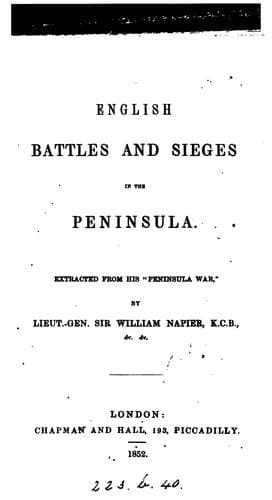
English Battles and Sieges in the Peninsula.: Extracted from his 'Peninsula War'.Napier, William Francis Patrick
History
English Battles and Sieges in the Peninsula.: Extracted from his 'Peninsula War'.
Napier, William Francis Patrick
Peninsular War, 1807-1814
Marmont then passed the Coa, but Grant preceded him, with intent to
discover if his further march would be by Guarda upon Coimbra, or by
Sabugal upon Castello Branco; for to reach the latter it was necessary
to descend from a very high ridge, or rather succession of ridges, by
a pass at the lower mouth of which stands Penamacor. Upon one of the
inferior ridges of this pass he placed himself, thinking the dwarf
oaks which covered the hill would secure him from discovery; but from
the higher ridge the French detected his movements with their glasses,
and in a few moments Leon, whose lynx eyes were always on the watch,
called out, _the French! the French!_ Some dragoons came galloping up,
Grant and his follower darted into the wood for a little space and then
suddenly wheeling rode off in a different direction; but at every turn
new enemies appeared, and at last the hunted men dismounted and fled on
foot through the low oaks; again they were met by infantry, detached
in small parties down the sides of the pass, and directed in their
chase by the waving of hats on the ridge above: Leon fell exhausted,
and those who first came up killed him in despite of his companion’s
entreaties: a barbarous action!
Grant they carried to Marmont, who invited him to dinner, and the
conversation turned on the prisoner’s exploits. The French marshal
said he had been long on the watch, knew all his captive’s haunts and
disguises, had discovered that only the night before he slept in the
French head-quarters, with other adventures which had not happened, for
this Grant never used any disguise; but there was another Grant, also
very remarkable in his way, who used to remain for months in the French
quarters, using all manner of disguises; hence the similarity of names
caused the actions of both to be attributed to one, and that is the
only palliative for Marmont’s subsequent conduct.
Treating his prisoner with apparent kindness, he exacted from him an
especial parole, that he would not admit a rescue by the Partidas while
on his journey through Spain to France: this secured his captive,
though Wellington offered two thousand dollars to any guerilla chief
who should recover him. The exaction of such a parole was a tacit
compliment to the man; but Marmont sent a letter with the escort to
the governor of Bayonne, in which, still in error as to there being
but one Grant, he designated his captive as a dangerous spy who had
done infinite mischief, and whom he had not executed on the spot out
of respect to something resembling uniform which he wore: he therefore
desired, that at Bayonne he should be placed in irons and sent to
Paris: this was so little in accord with French honour, that before
the Spanish frontier was passed Grant was made acquainted with the
treachery.
Public-domain text, read in full here on John Shaqi.
Reviews
Reviews
No reviews yet
Be the first to share your thoughts on this work.
Elsewhere in the archive
Join the Discussion
Join the discussion
Sign in to leave a comment or review.
Sign InorCreate an account