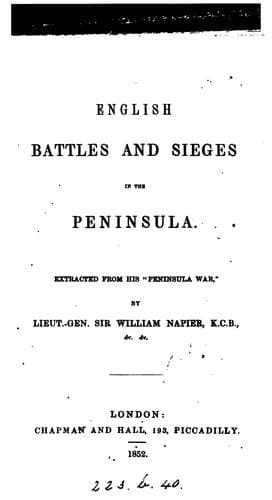
English Battles and Sieges in the Peninsula.: Extracted from his 'Peninsula War'.Napier, William Francis Patrick
History
English Battles and Sieges in the Peninsula.: Extracted from his 'Peninsula War'.
Napier, William Francis Patrick
Peninsular War, 1807-1814
Almaraz bridge had been destroyed to lengthen the French lateral line
of communication, Alcantara was now repaired to shorten the British
line; and though the break in that stupendous structure was ninety
feet wide and one hundred and fifty above the water, the genius of
Colonel Sturgeon overcame the difficulty. Hill’s army was thus brought
a fortnight nearer to Wellington than Drouet was to Marmont, if both
marched with artillery; and as the army of the centre was, by the
king’s misrule, in a state of great disorder, Marmont was for a time
isolated from all the other armies save that of the north, now under
General Caffarelli, who was however occupied by maritime expeditions
from Coruña.
Marmont was a man to be feared. He was quick of apprehension, morally
and physically brave, scientific, used to war, strong of body, in
the prime of life, eager for glory; and though neither a great nor a
fortunate commander, such a one as could bear the test of fire. He
had strongly fortified three convents at Salamanca, and having about
twenty-five thousand men in hand, demanded aid from the king, from
Soult, and from the army of the north. His design was to dispute the
Tormes and Duero in succession, the first by his forts, the second
with an army, which he could augment to forty-six thousand without
extraneous aid by calling Bonet’s division from the Asturias.
On the 13th of June Wellington advanced to the Tormes. The bridge
of Salamanca was barred by the French forts, all the others had
been destroyed save that of Alba de Tormes, the castle of which was
garrisoned; the allies however passed the river above and below
Salamanca by the fords of Santa Marta and Los Cantos, and General
Clinton invested the forts with the sixth division. Marmont, who had
two divisions and some cavalry, retired by the road of Toro. Salamanca
then became a scene of rejoicing. The houses were illuminated, the
people, shouting, singing and weeping for joy, gave Wellington their
welcome while his army took a position on the hill of San Christoval
five miles in advance.
SIEGE OF THE SALAMANCA FORTS. (June, 1812.)
Clinton had only four heavy guns and three twenty-four-pound howitzers,
but the train used by Hill at Almaraz had passed the Tagus at
Alcantara on its way up. The strength of the forts had however been
under-estimated, they contained eight hundred men. San Vincente, placed
on a perpendicular cliff overhanging the Tormes, had a fortified
convent within, and was well flanked and separated by a deep ravine
from the other forts; and these last, called San Cajetano and La
Merced, though smaller and of a square form, were bomb-proof and with
deep ditches.
Public-domain text, read in full here on John Shaqi.
Reviews
Reviews
No reviews yet
Be the first to share your thoughts on this work.
Elsewhere in the archive
Join the Discussion
Join the discussion
Sign in to leave a comment or review.
Sign InorCreate an account