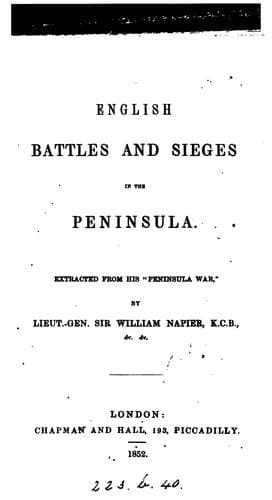
English Battles and Sieges in the Peninsula.: Extracted from his 'Peninsula War'.Napier, William Francis Patrick
History
English Battles and Sieges in the Peninsula.: Extracted from his 'Peninsula War'.
Napier, William Francis Patrick
Peninsular War, 1807-1814
To the officers of the allies all looked prosperous, they were
impatient for the signal of battle, and many complained that the
French had been permitted to retreat from Christoval; had Wellington
been finally forced back to Portugal, his reputation would have been
grievously assailed by his own people. The majority, peering forward
with misty political vision, overlooked the difficulties close at hand,
but their general was fretted with care and mortification, for all
cross and evil circumstances seemed to combine against him. The Spanish
coöperation had failed in all quarters, the enemy in front was growing
stronger, Soult was seriously menacing Cadiz, and the king was said
to have been joined by Drouet; the Portuguese troops were deserting
in great numbers from misery; the English government had absurdly and
perniciously interfered with the supply of the military chest; there
was no money and the personal resources of Wellington alone kept the
army in its forward position. “I have never,” said he, “been in such
distress as at present, and some serious misfortune must happen if
the government do not attend seriously to the subject and supply us
regularly with money. The arrears and distresses of the Portuguese
government are a joke to ours, and if our credit was not better than
theirs we should certainly starve. As it is, if we don’t find means to
pay our bills for butcher’s meat there will be an end to the war at
once.”
Thus stript as it were to the skin, he was going once more to hide his
nakedness in the mountains of Portugal, when Marmont, proud of his own
unripened skill, and perhaps, from the experience of San Christoval,
undervaluing his adversary’s tactics; desirous also, it was said, to
gain a victory without the presence of a king; Marmont, pushed on by
fate, madly broke the chain which restrained his enemy’s strength.
To understand the remarkable movements which were now about to
commence, it must be borne in mind that the French army, while the
harvest was on the ground, had no regard to lines of communication;
it had supports on all sides, and the troops were taught to reap the
standing corn, and grind it themselves if their cavalry could not seize
flour in the villages. This organization, approaching the ancient Roman
military perfection, baffled the irregular, and threw the regular force
of the allies entirely upon the defensive; their flanks once turned a
retreat must follow to save the communications; but the French offered
no point for retaliation. Wherefore, with a force composed of four
different nations, Wellington was to make difficult evolutions in an
open country, his only chances of success being the casual errors of
his adversary, an able general, who knew the country perfectly and had
troops well disciplined, and of one nation. The game would have been
quite unequal if the English had not been so strong in cavalry.
Public-domain text, read in full here on John Shaqi.
Reviews
Reviews
No reviews yet
Be the first to share your thoughts on this work.
Elsewhere in the archive
Join the Discussion
Join the discussion
Sign in to leave a comment or review.
Sign InorCreate an account