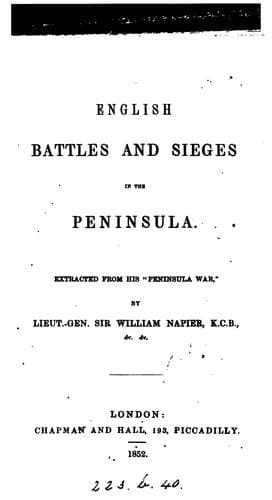
English Battles and Sieges in the Peninsula.: Extracted from his 'Peninsula War'.Napier, William Francis Patrick
History
English Battles and Sieges in the Peninsula.: Extracted from his 'Peninsula War'.
Napier, William Francis Patrick
Peninsular War, 1807-1814
The cannonade became heavy, and the spectacle surprisingly beautiful.
The lighter smoke and mist, mingling and curling in fantastic pillars,
formed a huge and glittering dome tinged with many colours by the
rising sun, and through the gross vapour below the restless horsemen
were seen or lost, as the fume thickened from the rapid play of the
artillery; the bluff head of land beyond the Trabancos, now covered
with French troops, appeared by an optical deception close at hand,
dilated to the size of a mountain, and crowned with gigantic soldiers,
who were continually breaking off and sliding down into the fight.
Suddenly a dismounted English cavalry officer stalked from the midst
of the smoke towards the line of infantry; his gait was peculiarly
rigid, and he appeared to hold a bloody handkerchief to his heart; but
that which seemed a cloth was a broad and dreadful wound: a bullet
had entirely effaced the flesh from his left shoulder and breast and
carried away part of his ribs, his heart was bared and its movement
plainly discerned. It was a piteous and yet a noble sight, for his
countenance though ghastly was firm, his step scarcely indicated
weakness, and his voice never faltered. This unyielding man’s name was
Williams. He died a short distance from the field of battle, it was
said in the arms of his son, a youth of fourteen, who had followed his
father to the Peninsula in hopes of obtaining a commission, for they
were not in affluent circumstances.
Cotton maintained this exposed position until seven o’clock, when
Wellington and Beresford came up, and both were like to have been
slain together. For a squadron of French cavalry, breaking away from
the head of land beyond the Trabancos, had just before come with such
speed across the valley that it was for a moment thought they were
deserting; but with headlong course they mounted the table-land on
which Cotton’s left wing was posted, and drove a whole line of British
cavalry skirmishers back in confusion. The reserves then came up from
Alaejos, and these furious swordmen, scattered in all directions, were
in turn driven away or cut down; yet thirty or forty, led by their
gallant officer, suddenly appeared above the ravine separating the
British wings, just as Wellington and Beresford arrived on the slope
beneath them. Some infantry picquets were in the bottom, higher up were
two guns covered by a squadron of light cavalry disposed in perfect
order, and when the French officer saw this squadron he reined in his
horse with difficulty, his men gathering in a confused body round him;
they seemed lost, but their daring leader waving his sword soused down
with a shout on the English troopers, who turning, galloped through the
guns, and the whole mass, friends and enemies, went like a whirlwind
to the bottom, carrying away in the tumult Wellington and Beresford.
The French horsemen were now quite exhausted and a reserve of heavy
dragoons cut most of them to pieces; yet their invincible leader,
Public-domain text, read in full here on John Shaqi.
Reviews
Reviews
No reviews yet
Be the first to share your thoughts on this work.
Elsewhere in the archive
Join the Discussion
Join the discussion
Sign in to leave a comment or review.
Sign InorCreate an account