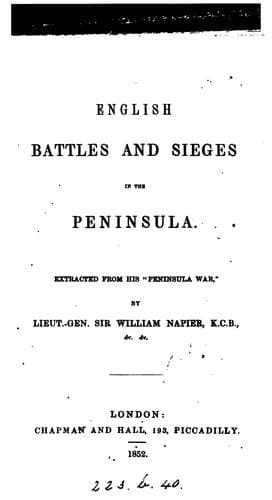
English Battles and Sieges in the Peninsula.: Extracted from his 'Peninsula War'.Napier, William Francis Patrick
History
English Battles and Sieges in the Peninsula.: Extracted from his 'Peninsula War'.
Napier, William Francis Patrick
Peninsular War, 1807-1814
The Guarena, flowing from four distinct sources which united below
Castrillo, offered a very strong line of defence; yet Marmont, hoping
to carry it in the first confusion, brought up all his artillery and
pushed the head of his right column over an upper branch. Wellington,
expecting this, had previously ordered up the other divisions of his
army, and they were in line before Marmont’s infantry, oppressed with
heat and long marches, could gather strength to attempt the passage
of the other branch. Carier’s brigade of cavalry first crossed, and
was followed by a column of infantry, just as the fourth division had
gained the table-land above. Carier’s horsemen entered the valley on
the left, the infantry in one column menaced the front, but the sedgy
banks of the stream would have been difficult to force, if Victor
Alten, slow to perceive an advantage, had not suffered the French
cavalry to cross first in considerable numbers without opposition. Then
he assailed them by successive squadrons instead of regiments, and
when the 14th and German Hussars were hard-pressed, brought up the 3rd
Dragoons, who were however driven back by the fire of the infantry, and
many fell. Finally Carier being wounded and taken, the French retired,
and meanwhile the 27th and 40th Regiments, coming down the hill, broke
the enemy’s infantry with an impetuous bayonet charge: Alten’s horsemen
then sabred some of the fugitives.
Marmont lost a general and five hundred soldiers by this combat, but,
though baffled at one point, and beaten at another, he concentrated
his army and held both banks of the branch he had gained. Wellington
also concentrated, and as the previous operations had only cost him
six hundred men and the French but eight hundred, the day being
still young, the positions open and within cannon-shot, a battle was
expected. Marmont’s troops had however been marching for two days and
nights, and Wellington’s plan did not admit of fighting unless in
defence, or with such advantage as that he could crush his opponent and
keep the field afterwards against the king.
The French marshal had passed a great river, surprised the allies’
right, and pushed it back above ten miles: he had nevertheless failed
as a general. His aim had been, by menacing the communication between
Salamanca and Rodrigo, to draw the allies back; yet on the evening of
the 16th, having passed the Duero at Toro, he was nearer to Salamanca
than they were, and, persisting, Wellington must have fought him at
disadvantage, or passed the Tormes at Huerta to regain the road of
Rodrigo. Marmont however relinquished this stroke to march eighty miles
in forty-eight hours, and after many nice evolutions, in which he lost
a thousand men by the sword and fatigue, found his adversary on the
18th facing him in the very position he had turned on the evening of
the 16th!
Public-domain text, read in full here on John Shaqi.
Reviews
Reviews
No reviews yet
Be the first to share your thoughts on this work.
Elsewhere in the archive
Join the Discussion
Join the discussion
Sign in to leave a comment or review.
Sign InorCreate an account