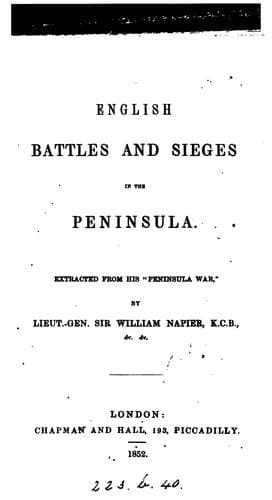
English Battles and Sieges in the Peninsula.: Extracted from his 'Peninsula War'.Napier, William Francis Patrick
History
English Battles and Sieges in the Peninsula.: Extracted from his 'Peninsula War'.
Napier, William Francis Patrick
Peninsular War, 1807-1814
Clausel marched upon Valladolid, abandoning the garrisons of Toro,
Tordesillas and Zamora, and, being still pressed by the British, went
up the Arlazan river. Then the king passed over the Guadarama mountains
to Madrid and Wellington entered Valladolid, where he found large
stores, seventeen pieces of artillery, and eight hundred sick and
wounded men. This terminated the Salamanca operations, which present
the following remarkable results. On the 18th of July Marmont’s army,
forty-two thousand sabres and bayonets with seventy-four guns, passed
the Duero to attack the allies. On the 30th it repassed that river
in retreat, having in those twelve days marched two hundred miles,
fought three combats, and a general battle, in which one marshal of
France, seven generals, and twelve thousand five hundred men and
inferior officers were killed, wounded or taken, together with two
eagles, several standards and twelve guns, exclusive of those found at
Valladolid. In the same period the allies, who had forty-six thousand
sabres and bayonets, with sixty guns, the excess of men being Spanish,
marched one hundred and sixty miles, and had one marshal, Beresford,
four generals and six thousand men and officers killed or wounded.
BOOK VIII.
Madrid--Siege of Burgos--Retreat from Burgos--Combat of Venta
de Pozo--Combat on the Carion--Retreat from Madrid--Alba de
Tormes--Combat of the Huebra.
MADRID. (Aug. 1812.)
Wellington, having entirely separated the king’s army from Marmont’s,
had to choose between pursuing the latter and besieging Burgos, or
marching on Madrid. He adopted the last, and crossing the Guadarama
mountains descended on the Spanish capital, leaving General Clinton
with twelve thousand men to watch Clausel and co-operate with Spaniards
from Gallicia. Joseph had good troops, and being unwilling to fly
before a detachment occupied the Escurial, placing detachments on
all the roads. In this state D’Urban’s Portuguese cavalry drove back
Trielhard’s outposts and entered Majadahonda. Some German infantry,
Bock’s heavy cavalry, and a troop of horse-artillery then entered
Las Rozas, a mile in D’Urban’s rear; but in the evening, Trielhard,
reinforced by Schiazzetti’s Italian dragoons and the lancers of
Berg, returned; D’Urban called up the horse artillery and would
have charged, but his Portuguese fled, and three of the guns being
overturned on rough ground were taken. The victorious cavalry passed
through Majadahonda in pursuit, and though the German dragoons, albeit
surprised in quarters, stopped the leading French squadrons, yet,
when Schiazzetti’s horse came up, the fight would have ended badly if
Ponsonby’s cavalry and the seventh division had not arrived. Trielhard
then retired, carrying away captive, the Portuguese general, Visconde
de Barbacena, the colonel of the German cavalry, and others of less
rank. The whole loss was above two hundred, and the German dead lay
Public-domain text, read in full here on John Shaqi.
Reviews
Reviews
No reviews yet
Be the first to share your thoughts on this work.
Elsewhere in the archive
Join the Discussion
Join the discussion
Sign in to leave a comment or review.
Sign InorCreate an account