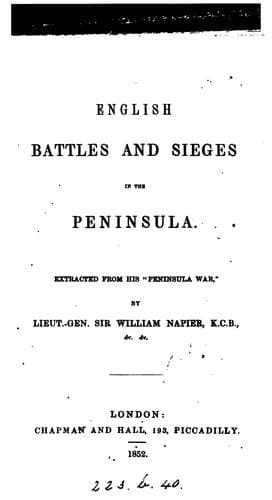
English Battles and Sieges in the Peninsula.: Extracted from his 'Peninsula War'.Napier, William Francis Patrick
History
English Battles and Sieges in the Peninsula.: Extracted from his 'Peninsula War'.
Napier, William Francis Patrick
Peninsular War, 1807-1814
On the 21st the garrison mounted several field-guns, and at night fired
heavily with grape and shells on the workmen digging the musketry
trench. The 22nd this fire was redoubled, yet the besiegers worked with
little loss, and their musketeers galled the enemy. In the night the
battery was armed with two eighteen-pounders and three howitzers, and
the secret battery within the horn-work was commenced; but Wellington,
now deviating from his first plan, directed an escalade against the
first line. In this view, at midnight four hundred men with ladders
were secretly posted in a hollow road, fifty yards from the wall, which
was from twenty-three to twenty-five feet high without flanks; and to
aid this main column, a Portuguese battalion was assembled in the town
of Burgos for a flank attack.
SECOND ASSAULT. (Sept. 1812.)
In this assault, although the Portuguese were repelled by the fire of
the common guard, the principal party, composed of detachments under
Major Lawrie, entered the ditch, yet altogether and confusedly; Lawrie
was killed, the soldiers who mounted the ladders were bayoneted,
combustible missiles were thrown down in abundance, and the men gave
way, leaving half their number behind. The wounded were brought off
next day under a truce, and it is said, that on the body of an officer
the French found a complete plan of the siege. It was a very disastrous
attempt, which delayed the regular progress for two days, increased the
enemy’s courage and produced a bad effect upon the troops, some of whom
were already dispirited by the storm of the horn-work.
The original plan being now resumed, the hollow way from whence the
escaladers had advanced, running along the front of defence, was
converted into a parallel, and the trench made deep and narrow to
secure them from the plunging shot of the castle. Musketeers were also
planted to keep down the enemy’s fire. But heavy rains incommoded the
troops, and the French raised a palisaded work on their own right,
which flanked this parallel, and from thence they killed so many of the
besiegers’ marksmen that the latter were withdrawn.
In the night a flying sap from the right of the parallel was pushed
within twenty yards of the first line; but the directing engineer was
killed, and with him many men, for the French plied their musketry
sharply, and rolled large shells down the steep side of the hill. The
head of the sap was indeed so commanded as it approached the wall, that
a six-feet trench, added to the height of the gabions above, scarcely
protected the workmen; wherefore the gallery for a mine was worked as
rapidly as the inexperience of the miners would permit.
Public-domain text, read in full here on John Shaqi.
Reviews
Reviews
No reviews yet
Be the first to share your thoughts on this work.
Elsewhere in the archive
Join the Discussion
Join the discussion
Sign in to leave a comment or review.
Sign InorCreate an account