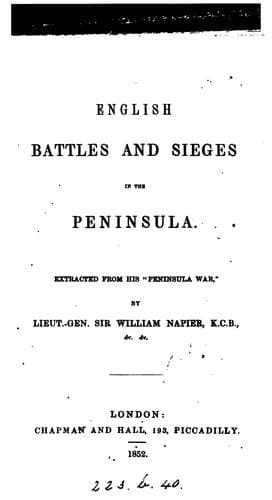
English Battles and Sieges in the Peninsula.: Extracted from his 'Peninsula War'.Napier, William Francis Patrick
History
English Battles and Sieges in the Peninsula.: Extracted from his 'Peninsula War'.
Napier, William Francis Patrick
Peninsular War, 1807-1814
At midnight, the hollow road being lined with men to fire on the
defences, the storming party, three hundred strong, was assembled
there, attended by others who carried tools and materials to secure
a lodgement when the breach should be carried. The mine was then
exploded, the wall fell, and an officer with twenty men rushed forward
to the assault. The effect of the explosion was disappointing, yet it
cast the wall down, the enemy was stupefied, and the forlorn hope, a
sergeant and four daring soldiers, gained the summit of the breach;
soon however the French recovered, and threw them over pierced with
bayonet wounds. Meanwhile the officer, with his twenty men, missed the
breach in the dark, and finding the wall unbroken returned, saying
there was no breach; then the main body regained the trenches, and
before the sergeant and his comrades came in with streaming wounds to
tell their tale the enemy was reinforced: the scarcity of ammunition
would not permit a fire to be directed upon the work during the night,
and the French, raising a parapet behind it, placed obstacles on the
ascent which deterred the besiegers from renewing the assault at
daylight.
Twelve days had now elapsed since the siege commenced, one assault
had succeeded, two had failed, twelve hundred men had been killed or
wounded, little progress was made, and the troops were dispirited,
notably the Portuguese, who seemed to be losing their ancient spirit.
Discipline was relaxed, ammunition was wasted, work in the trenches
avoided and neglected by officers and men, insubordination was gaining
ground, and reproachful orders were issued, the Guards only being
noticed as presenting an honourable exception.
The French marksmen in the flanking palisaded work were so expert
that everything which could be seen from thence was hit, until the
howitzer battery on San Michael was reinforced with a captured French
eighteen-pounder, and this mischievous post was at last demolished. At
the same time the gallery of the second mine was pushed forward, and a
new breaching battery for three guns constructed behind it, so close
to the enemy’s defences that they screened it from the artillery fire
of their upper fortress. To arm this work the three eighteen-pounders
were dragged in the night from San Michael, and next day were, under
a musketry fire which thinned the workmen, placed in battery; but the
watchful Dubreton brought a howitzer down, with which he threw shells
into the battery, and making a hole through a flank wall, thrust out
a light gun also, which sent its bullets whizzing through the thin
parapet of the work at every round. The allies were thus driven from
their post, more French cannon were brought from the upper works, and
the battery was demolished; two of the gun-carriages were disabled, a
trunnion was knocked off one of the guns, and the muzzle of another
split: and vainly the marksmen endeavoured to quell this fire, the
French eventually remained masters.
Public-domain text, read in full here on John Shaqi.
Reviews
Reviews
No reviews yet
Be the first to share your thoughts on this work.
Elsewhere in the archive
Join the Discussion
Join the discussion
Sign in to leave a comment or review.
Sign InorCreate an account