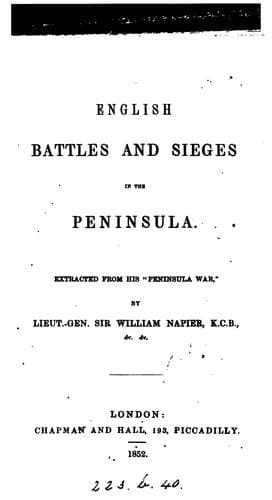
English Battles and Sieges in the Peninsula.: Extracted from his 'Peninsula War'.Napier, William Francis Patrick
History
English Battles and Sieges in the Peninsula.: Extracted from his 'Peninsula War'.
Napier, William Francis Patrick
Peninsular War, 1807-1814
Joseph, thinking to prevent Hill’s junction, had gained Arevalo by
the Segovia road, and on the 8th, Souham’s scouts being met with at
Medina del Campo, the king, for the first time since he had quitted
Valencia, obtained news of the army of Portugal. One hundred thousand
combatants, of which above twelve thousand were cavalry, with a hundred
and thirty pieces of artillery, were then assembled on plains, over
which, three months before, Marmont had marched with such confidence
to his own destruction; and Soult, then expelled from Andalusia by
Marmont’s defeat, was now, after having made half the circuit of the
Peninsula, come to drive into Portugal that very army whose victory had
driven him from the south. Wellington had foreseen, and foretold, that
the acquisition of Andalusia, though politically important and useful,
would prove injurious to himself at the moment. The prophecy was
fulfilled. The French had concentrated a mighty power, from which it
required both skill and fortune to escape. Meanwhile the Spanish armies
let loose by this union of all the French troops kept aloof, or, coming
to aid, were found a burden rather than a help.
On the 7th Hill passed the Tormes at Alba, and the bridge there was
mined; for Wellington, holding Christoval and being still uncertain of
the real numbers of the enemy, was desirous to maintain the line of the
Tormes permanently and give his troops repose. His own retreat had been
of two hundred miles; Hill had marched a greater distance; Skerrett had
come from Cadiz; the soldiers who besieged Burgos had been in the field
with scarcely an interval of repose since January; all were barefooted,
their equipments were spoiled, the cavalry were weak, the horses out of
condition, and discipline was generally failing.
The excesses committed on the retreat from Burgos have been touched
upon; and during the first day’s march from the Tagus to Madrid,
five hundred of the rear-guard, chiefly of one regiment, finding the
inhabitants of Valdemoro had fled, plundered the houses; drunkenness
followed and two hundred and fifty fell into the hands of the enemy.
The conduct of an army can never be fairly judged by following in the
wake of a retreat. Here there was no want of provisions, no hardships
to exasperate, yet the author of this history counted on the first
day’s march from Madrid seventeen bodies of murdered peasants; by whom
killed, or for what, whether by English or Germans, by Spaniards or
Portuguese, whether in dispute, in robbery, or in wanton villany, was
unknown; but their bodies were in the ditches, and a shallow observer
might thence have drawn most foul and false conclusions against the
English general and nation.
Public-domain text, read in full here on John Shaqi.
Reviews
Reviews
No reviews yet
Be the first to share your thoughts on this work.
Elsewhere in the archive
Join the Discussion
Join the discussion
Sign in to leave a comment or review.
Sign InorCreate an account