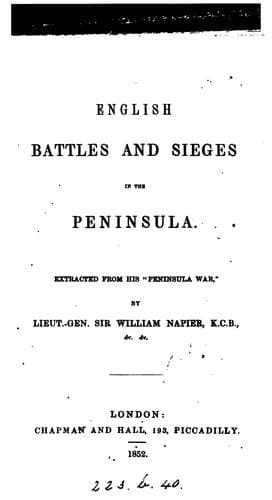
English Battles and Sieges in the Peninsula.: Extracted from his 'Peninsula War'.Napier, William Francis Patrick
History
English Battles and Sieges in the Peninsula.: Extracted from his 'Peninsula War'.
Napier, William Francis Patrick
Peninsular War, 1807-1814
While these events passed in Guipuscoa, Clausel was more hardly pressed
on the other flank of the allies. He had approached Vittoria with
fourteen thousand men on the 22nd, but finding Pakenham there with
the 6th division, retired to Logroño and halted until the evening of
the 23rd, thus enabling Wellington, who thought he was at Tudela, to
discover his real situation and march against him. He fled to Tudela,
reached it the 27th, after a march of sixty miles in forty hours, and
thinking he had outstripped his pursuers proposed to enter France by
Taffalla and Olite, but an alcalde told him Wellington had forestalled
him at those places and he marched upon Zaragoza. He could have been
intercepted again, yet Wellington, fearing to drive him on Suchet, only
launched Mina in pursuit, and Clausel after destroying guns and baggage
finally escaped by Jacca into France. The king had meanwhile caused
Gazan to re-enter Spain by the Bastan, from whence Hill quickly drove
him. Joseph’s reign was over. After years of toils and combats, admired
rather than understood, Lord Wellington, emerging from the chaos of the
Peninsula struggle, crowned the Pyrenees--a recognized conqueror. From
that pinnacle the clangour of his trumpets was heard, and the splendour
of his genius blazed out, a flaming beacon for warring nations.
BOOK X.
Battle of Castalla--English Siege of Taragona--Siege of San
Sebastian--Storming of San Bartolomeo--First Storm of San
Sebastian.
While the main armies strove in the north of Spain, the Mediterranean
coast was the scene of a secondary contest maintained by an English
expedition sent from Sicily in 1812. Destined at first for Catalonia,
it finally landed at Alicant, where it remained inactive until April,
1813, but then Sir John Murray, whose want of vigour on the Douro
was overbalanced by aristocratic influence at home, assumed command.
Acting in conjunction with the Spanish general Elio, he commenced a
series of petty enterprises, and broached several projects which he had
not nerve to execute, and only roused Suchet to serious action. That
marshal, previously inert, concentrated in the night of the 11th all
his disposable force, and next morning falling upon Mijares, Elio’s
lieutenant, defeated him with a loss of fifteen hundred prisoners. Then
he marched against Murray, who retreated through the pass of Biar to
a position of battle, leaving Colonel F. Adam with two thousand five
hundred men and six guns in the defile. The ground was very strong, but
the French light troops crowned the rocks on each side and after two
hours’ fighting the allies abandoned the pass, with a loss of two guns
and some prisoners besides killed and wounded, yet made their retreat,
three miles, to the main position, in good order, and were not pursued.
Public-domain text, read in full here on John Shaqi.
Reviews
Reviews
No reviews yet
Be the first to share your thoughts on this work.
Elsewhere in the archive
Join the Discussion
Join the discussion
Sign in to leave a comment or review.
Sign InorCreate an account