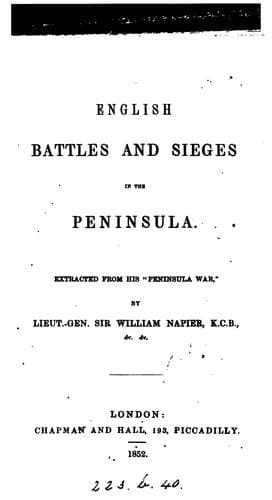
English Battles and Sieges in the Peninsula.: Extracted from his 'Peninsula War'.Napier, William Francis Patrick
History
English Battles and Sieges in the Peninsula.: Extracted from his 'Peninsula War'.
Napier, William Francis Patrick
Peninsular War, 1807-1814
Westward there were only two carriage-ways from Tortoza. One direct,
by the Col de Balaguer to Tarragona; the other circuitous, leading by
Mora, Falcet, Momblanch and Reus. The capture of San Felippe blocked
the first, the second was in bad order, and at best only available for
small mountain-guns.
Northward there was a carriage-way leading from Lerida, which united
with that from Falcet at Momblanch.
Eastward was the royal causeway from Barcelona, running through Villa
Franca and Torredembarra, and after passing Villa Franca sending two
branches to the right, one through the Col de Cristina, the other
through Col de Leibra.
Between these various roads the mountains were too rugged to permit
cross communications; troops coming from different sides could only
unite in the Campo de Tarragona; where Murray, who had fifteen
thousand fighting men, and Copons, who had six thousand regulars and
the irregular division of Manso, could present twenty-five thousand
combatants.
Copons indeed told Murray, that his troops could only fight in
position, and he would not join in any operation to endanger his
retreat into the mountains; but his force, the best in Spain, was now
at Reus and the Col de Balaguer, ready to harass and oppose any French
corps which should attempt to descend into the Campo. Murray could
also calculate upon seven or eight hundred seamen and marines to aid
him in the siege, or in a battle near the shore, and he expected three
thousand fresh troops from Sicily. Sir Edward Pellew, commanding the
great Mediterranean fleet, promised to distract the French by a descent
eastward of Barcelona, and a general rising of the Somatenes might have
been effected: those mountaineers were indeed all at his disposal, to
procure intelligence, to give timely notice of the French marches and
impede them by breaking up the roads.
The French power was greater yet more scattered. On the west Suchet,
coming with nine thousand men from Valencia, was to be reinforced
by Pannetier’s brigade and some troops from Tortoza, up to eleven
or twelve thousand men with artillery; but the fall of San Felippe
de Balaguer barred his only carriage-way, and the road by Mora and
Momblanch, which remained open, was long and bad. On the eastern side
Maurice Mathieu could bring seven thousand men with artillery from
Barcelona; Decaen could move from the Ampurdam with an equal number,
and thus twenty-five thousand men in all might finally bear upon the
allied army.
Public-domain text, read in full here on John Shaqi.
Reviews
Reviews
No reviews yet
Be the first to share your thoughts on this work.
Elsewhere in the archive
Join the Discussion
Join the discussion
Sign in to leave a comment or review.
Sign InorCreate an account